Provenance-Aware RAG: Preserving Evidence Lineage Through Transformations, Summaries, and Multi-Hop Synthesis
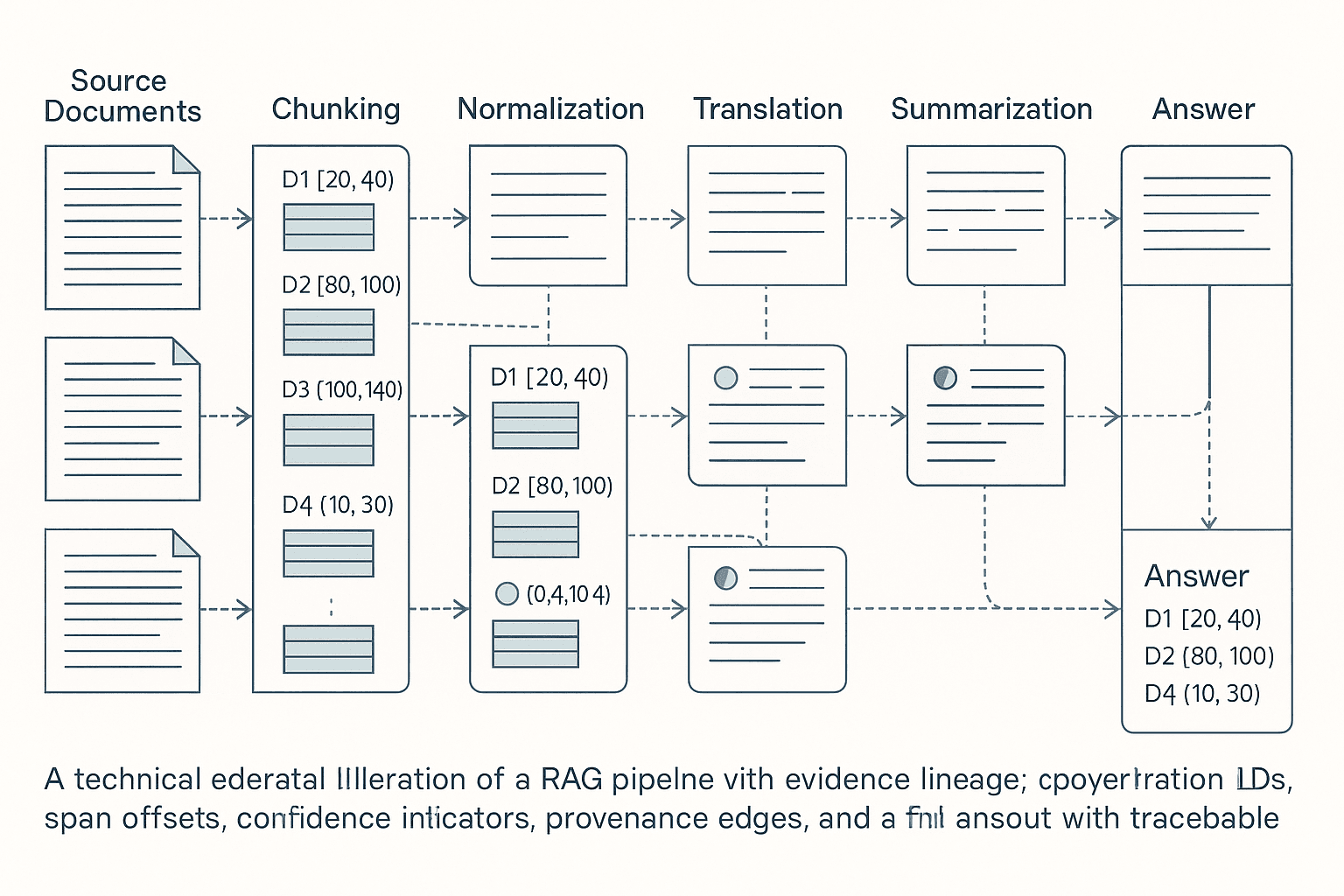
A team ships a polished internal research assistant for policy and compliance. Early demos are excellent: answers are fluent, the interface shows citations, and retrieval looks strong on top-line accuracy metrics. Then the incident report lands.
A regional compliance lead asks whether a specific customer data retention exception applies to archived support logs. The assistant answers confidently, cites two documents, and recommends a retention period that is shorter than policy allows. After review, nobody finds an outright hallucination in the usual sense. The cited documents are real. The answer even sounds plausible. The failure is subtler and more dangerous: the evidence lineage broke.
One cited snippet came from a summary document produced by an ingestion job that compressed a 40-page policy memo into bullet points. Another came from a translated version of a regional appendix. During preprocessing, the system normalized headings, removed repeated boilerplate, merged table rows into prose, and chunked text for embedding. Later, a reranker selected the summarized chunk over the original because it scored higher semantically. During answer synthesis, the model fused the summary and translated appendix into a recommendation. The displayed citations pointed to intermediate artifacts, not the exact originating language in the source record. A reviewer could not reconstruct which original sentences supported which answer clause, or whether the transformation pipeline had dropped a qualifier like “except where legal hold applies.”
This is where many production RAG systems get exposed. The naive mental model is that “citations” mean provenance. In practice, most RAG stacks preserve document identity at best, chunk identity sometimes, and true evidence lineage almost never. As soon as content is transformed—cleaned, deduplicated, OCR-corrected, translated, summarized, table-linearized, or merged across hops—the relationship between final answer text and original source spans becomes lossy unless you model and enforce it deliberately.
If your system is used for support, policy, legal, finance, medicine, procurement, security operations, or any workflow where users treat citations as evidence rather than decoration, provenance awareness is not a nice-to-have. It is the control that keeps “well cited” from turning into “unsupported but attractively formatted.”
What follows is a production-focused approach to provenance-aware RAG: the data model, the architecture, the retrieval and synthesis patterns, the span mapping mechanics, the audit records, and the evals that catch lineage breakage before it reaches users.
The pattern behind the failure
Most lineage failures in RAG come from one of five patterns.
First, transform-without-trace. You normalize or summarize content to improve retrieval quality or reduce token cost, but you do not retain exact mappings from transformed text back to source spans.
Second, citation laundering. A downstream stage cites an intermediate artifact, like a summary, extracted table, or translated chunk, and the UI presents that as if it were primary evidence.
Third, multi-hop drift. Hop one retrieves relevant context, hop two creates a working note or sub-answer, hop three synthesizes a final answer. Each step is locally reasonable, but support for a key claim weakens or mutates as qualifiers are dropped.
Fourth, span ambiguity. Your citations point to a page, document, or chunk, but not the precise language supporting a claim. Reviewers can usually find something nearby that feels related, which masks unsupported leaps.
Fifth, ranking inversion. A transformed artifact outranks the original because it is shorter, cleaner, or more semantically aligned with the query embedding, so the model sees the derivative more often than the primary source.
If you only measure retrieval recall and answer quality by human preference, these failures can hide in plain sight. The assistant sounds good. Citations exist. Stakeholders assume governance is covered. It is not.
Why the naive approach fails
The default RAG architecture works like this: ingest documents, chunk them, embed chunks, retrieve top-k chunks, rerank, stuff context into a prompt, and ask the model to answer with citations. This is enough for prototypes and some low-risk search tasks. It is not enough for evidence-sensitive systems.
There are three structural reasons.
1. Chunk IDs are not provenance
A chunk ID tells you where the model got a piece of context, not what exact original text supports a generated claim. Once a chunk has gone through preprocessing, the chunk is already a derivative artifact. For example:
- OCR fixed spelling and punctuation.
- Headers and footers were removed.
- Table structure was flattened into sentences.
- Duplicates were collapsed.
- Language was translated.
- A summary was generated.
If the final answer cites chunk_18492, that is not evidence lineage. It is a pointer into your pipeline.
2. LLM synthesis is compositional and lossy
Models are good at combining partial evidence into a coherent answer. They are also good at smoothing over uncertainty and eliding caveats. In multi-hop settings, that compositional ability becomes a risk surface.
Suppose one source says “retention may be reduced for archived logs” and another says “exceptions do not apply under active legal hold.” A summarizer might compress the second to “exceptions limited during legal reviews,” a reranker might drop that chunk because it looks less relevant, and the final answer may recommend a reduced retention period without the legal-hold caveat. No single step looks catastrophic. The chain as a whole becomes unsupported.
3. Citations are often attached after generation
Many systems ask the model to answer first and cite second, or they perform citation matching after generation by linking answer sentences to the nearest chunks. This is better than nothing, but it is fundamentally post hoc. It does not constrain the model to only emit claims grounded in traceable evidence; it only decorates claims after the fact.
In production, post hoc citations create a false sense of security because unsupported claims often get mapped to vaguely related chunks.
The better approach: provenance as a first-class system property
The more robust pattern is to treat provenance as a typed graph that survives every transformation and to make citation integrity a gating requirement for answer delivery.
At a high level:
- Represent every artifact and transformation explicitly.
- Maintain span-level lineage edges whenever text changes.
- Differentiate primary evidence from derivative artifacts.
- Generate answers claim-by-claim with evidence bindings.
- Validate that each claim is supported by traceable primary spans.
- Run evals that intentionally stress lineage breakage.
This sounds heavier than standard RAG because it is. But if your users rely on citations to make decisions, the cost is justified.
A concrete architecture for provenance-aware RAG
Here is a practical architecture that teams can actually implement without turning the system into a research project.
Layer 1: Source registry
Store immutable source records with stable identifiers.
Each source should have:
source_idsource_type(pdf, html, docx, email, db row export, transcript, etc.)origin_uriversion_idingested_atchecksumjurisdiction,language,owner,access_policy- raw bytes or a canonical archival copy
Do not overwrite. Version sources append-only.
Layer 2: Canonical text extraction
Extract text into a canonical representation while preserving layout anchors.
For each extracted segment:
artifact_idartifact_type = canonical_extractsource_id,version_idpage_number,section_path,table_id,cell_coordsas availabletextchar_start,char_endwithin the canonical artifact- confidence from OCR/parser
This becomes your first derivation layer from raw source. The canonical extract is not yet “truth,” but it is your stable textual substrate.
Layer 3: Transformation graph
Every downstream artifact is created by a named transformation with metadata.
Examples:
- normalization
- boilerplate removal
- deduplication
- chunking
- language translation
- table linearization
- summarization
- entity extraction
- redaction
Each transformation record should include:
transformation_idtransform_typeinput_artifact_idsoutput_artifact_idstool_nameand versionmodel_nameand version if applicable- prompt/template hash if LLM-mediated
- parameters
- execution timestamp
- operator/service identity
- quality/confidence metadata
This is the audit backbone.
Layer 4: Span lineage map
This is the hard part and the most important.
For any transformation that changes text, store mappings between output spans and input spans.
A span mapping table can look like:
mapping_idtransformation_idoutput_artifact_idoutput_start,output_endinput_artifact_idinput_start,input_endmapping_type(exact_copy,normalized,translated,paraphrased_summary,table_to_text,merged,split)support_weightconfidence
One output span may map to multiple input spans, especially for summaries or table linearization. One input span may map to multiple outputs. That is fine; provenance is naturally many-to-many.
Layer 5: Retrieval indices by artifact class
Do not throw all artifacts into one embedding index and call it a day. Maintain separate or tagged indices at least for:
- primary evidence artifacts
- normalized/chunked derivatives
- summaries
- translations
- structured extractions
Then control ranking policies so derivatives help retrieval but do not silently replace primary evidence.
A common production pattern is:
- retrieve on normalized chunks and summaries for recall
- expand retrieved items to their provenance-linked primary spans
- rerank the primary spans for final evidence set
- only expose primary or near-primary artifacts as user-visible citations, with derivatives clearly labeled as assistive context
Layer 6: Claim-grounded synthesis
Do not ask the model for one monolithic answer with “please cite sources.” Instead use a two-stage synthesis pattern.
Stage A: Claim plan
- break the answer into atomic claims or answer units
- for each claim, bind candidate evidence spans before freeform generation
Stage B: Constrained synthesis
- generate each claim using only bound evidence
- require a citation object referencing supporting span IDs
- mark claims as unsupported if evidence is insufficient
This can be done with structured generation. A response object might include:
claim_textsupporting_span_idssupport_level(direct,inferred,insufficient)derivation_notes
Then a postprocessor assembles the final answer while preserving per-claim citation lineage.
Layer 7: Citation integrity gate
Before an answer is shown, run validation checks:
- every claim must reference at least one supporting span
- every supporting span must resolve through lineage to a primary source span
- derivative-only support is disallowed or visually downgraded depending on policy
- inferred claims need either multiple supporting spans or explicit uncertainty labeling
- any span mapped through low-confidence OCR/translation/summarization paths may require a warning or fallback to extractive output
If the gate fails, the system should degrade gracefully:
- answer with narrower scope
- return extractive evidence only n- ask a clarifying question
- escalate to a human workflow
Designing the provenance data model
Teams often overcomplicate provenance by reaching for a fully general knowledge graph too early. Start with a relational model or document model that supports graph traversal patterns.
A practical minimum schema has five core entities:
SourceRecordArtifactTransformationSpanSpanMapping
You can materialize spans explicitly or treat them as offset ranges attached to artifacts. I usually recommend explicit span records only for spans that matter operationally: retrieved windows, citation targets, transformed segments, and answer-bound evidence. Do not create a database row for every sentence in every document unless you need it.
A simplified model:
textSourceRecord(source_id, version_id, origin_uri, checksum, metadata...)

Artifact(artifact_id, artifact_type, source_id, version_id,
         parent_artifact_id nullable, text, language, metadata...)

Transformation(transformation_id, transform_type,
               tool_name, tool_version, model_name nullable,
               prompt_hash nullable, parameters_json, metadata...)

TransformationIO(transformation_id, input_artifact_id, output_artifact_id)

Span(span_id, artifact_id, start_offset, end_offset,
     locator_json, text_snapshot nullable)

SpanMapping(mapping_id, transformation_id,
            output_span_id, input_span_id,
            mapping_type, support_weight, confidence)
This is enough to answer operational questions like:
- Which original source spans support this answer sentence?
- Which transformations touched them?
- Was a summary or translation involved?
- What model and prompt produced the summary?
- Which ingestion version was active at answer time?
That is what auditors, incident responders, and skeptical enterprise buyers eventually ask.
Span mapping strategies that work in practice
The hardest engineering work here is maintaining useful span mappings as text changes.
Exact and near-exact transforms
For operations like whitespace normalization, Unicode cleanup, boilerplate stripping, and section splitting, use deterministic char-offset maps.
Technique:
- emit a transformation transcript during processing
- track kept/deleted/inserted ranges
- build an offset translation table from output char positions back to input char positions
This is straightforward and highly reliable.
Chunking
Chunking should preserve source offsets exactly.
Each chunk artifact should carry:
- source artifact ID
- chunk start/end offsets in parent artifact
- overlap ranges
- section/page metadata
Chunking is often where teams first lose precision because they store only chunk text and metadata like “page 4.” Store offsets.
Table linearization
When converting tables to text, keep cell-level provenance.
For example, if a row becomes:
Region EU — Retention Exception: No, unless legal hold review completed.
map each phrase back to the cell or header cells that contributed it. For synthesized table prose, allow multiple input spans with weights. Otherwise you will never be able to defend how the generated sentence emerged.
Translation
Translation is dangerous for lineage because exact span alignment is approximate.
Recommendations:
- keep the original-language artifact as primary evidence
- store translated artifacts as derivatives
- use sentence- or clause-level alignment, not only document-level linkage
- where possible, use translation systems that return token or segment alignment metadata
- display citations to original plus translated rendering in the UI, not translation alone
For high-risk settings, answer synthesis should reason over both original and translated spans when feasible, or at least retain the original alongside the translation in context.
Summarization
Summary provenance is where naive systems fail hardest.
Do not treat a summary sentence as if it were source evidence. Treat it as a routing and compression artifact that must point back to one or more supporting source spans.
A practical summarization pattern:
- Summarize section-by-section, not whole documents at once.
- Require structured output where each summary bullet includes
source_span_ids. - Reject bullets without support.
- Store summary bullets as separate artifacts or spans, each with mappings to underlying spans.
- During answer generation, use summaries to find candidates but resolve back to original spans before final support.
This makes summaries useful without laundering them into primary evidence.
Multi-hop synthesis without provenance drift
Multi-hop workflows are common in enterprise RAG:
- retrieve policy definition
- retrieve regional exception
- retrieve customer-specific contract clause
- combine them into a recommendation
The failure mode is that hop outputs become unofficial facts.
A better pattern is a working memory ledger instead of freeform chain-of-thought-like summaries. Each hop writes structured records:
propositionstatus(supported,conflicted,tentative)supporting_span_idsconflicting_span_idsnormalization_notes
For example:
json{
  "proposition": "Archived support logs are generally retained for 24 months.",
  "status": "supported",
  "supporting_span_ids": ["s101", "s244"],
  "conflicting_span_ids": [],
  "normalization_notes": "Policy memo and retention schedule agree on 24 months."
}
Later hops consume ledger entries plus underlying evidence IDs, not just prose notes. The final synthesizer can then compose the answer from propositions whose support is explicit.
This also helps with contradictions. If regional and global policies conflict, the system can surface both and explain precedence rules, rather than blending them into a false certainty.
Retrieval and ranking strategies that preserve lineage
Provenance-aware RAG usually benefits from a hybrid retrieval design.
Recommended pattern
-
Recall layer
- BM25 or sparse retrieval over normalized text
- embeddings over normalized chunks
- optional summaries as expansion artifacts
-
Provenance expansion
- for each retrieved derivative artifact, fetch linked primary source spans and adjacent context windows
-
Evidence reranking
- rerank primary spans against the query or claim, not just the derivative chunk
- apply penalties if support comes only through low-confidence transformations
-
Coverage assembly
- select evidence spans to maximize support coverage across anticipated subclaims, not just top relevance score
Why this works
Summaries and normalized chunks are often better retrieval handles than raw documents. But if you let them dominate the final context window, you increase citation laundering risk. Provenance expansion lets you use derivatives for recall while grounding final generation in source-near evidence.
Model/tool comparisons
For retrieval:
- Sparse retrieval is still strong for policy, legal, and compliance corpora where exact terminology matters.
- Dense embeddings help with paraphrase and cross-document concept matching.
- Late interaction or cross-encoder rerankers often improve precision significantly for claim-level evidence selection, at extra latency.
For transformations:
- Deterministic processors should handle normalization, structure parsing, and offset mapping wherever possible.
- LLMs are appropriate for summarization, table interpretation, and difficult OCR cleanup, but every LLM-mediated transformation should be logged and treated as derivative.
For synthesis:
- a larger model may be worth using only in the final claim-grounded synthesis step
- cheaper models often suffice for recall expansion, classification, and structured proposition extraction
This is one of the cleanest ways to manage cost: spend tokens where reasoning matters, not on every preprocessing stage.
Cost and latency tradeoffs
Provenance awareness adds overhead. You should go in with eyes open.
Storage cost
You will store:
- more artifacts
- transformation metadata
- span mappings
- answer-time evidence records
This can be significant, especially with long documents and multiple derivative forms. Mitigations:
- keep span mappings at sentence/clause granularity for expensive transforms like summaries and translations
- use char-offset maps only where deterministic and compressible
- archive cold lineage data to cheaper storage while keeping hot indices lean
Ingestion latency
Lineage-preserving ingestion is slower than naive chunk-and-embed.
Expensive stages include:
- table parsing
- translation alignment
- summary-with-citations generation
- validation of unsupported summary bullets
For many enterprise workloads, this is acceptable because ingestion is offline and answer quality matters more than ingest speed.
Query latency
Additional latency comes from:
- provenance expansion
- claim decomposition
- evidence reranking
- citation integrity validation
Mitigations:
- cache provenance expansions for popular documents
- run retrieval and provenance fetch in parallel
- use a small model for claim planning
- limit claim count for short answers
- precompute section summaries with source-span IDs
A common production target is to keep the answer path under a few seconds for interactive use while allowing a slower “high-assurance mode” for sensitive queries.
UX tradeoff
Strict provenance gating can make the assistant say “I can’t support that from the retrieved evidence” more often. That can feel worse in demos and better in real life. Be intentional: for high-risk domains, a narrower supported answer is a feature, not a defect.
Implementation details that matter more than people think
1. Make citation targets immutable
If chunk boundaries or normalized text can change under the same IDs, you have broken auditability. IDs for source versions, artifacts, and citation spans must be content-stable or versioned.
2. Store text snapshots for cited spans
Even if spans are offset-based, storing a short text snapshot with the citation record helps incident review and catches offset drift bugs after reprocessing.
3. Keep transformation prompts hashed and versioned
If an LLM-generated summary or translation influenced an answer, you should be able to identify which prompt template and model version produced it.
4. Distinguish support types
Not all support is equal. Track whether a claim is:
- directly stated
- synthesized from multiple spans
- inferred from structured data
- translated support
- summary-mediated support
This can drive UI labels and policy gates.
5. Treat OCR confidence as provenance risk
Bad OCR is a lineage issue, not just a parsing issue. Low-confidence OCR should lower trust in downstream support chains.
6. Build reviewer tools early
You need an internal evidence inspector that shows:
- answer claim
- cited span
- source document/page/section
- full transformation path
- neighboring source context
- any summaries/translations involved
Without this, your team cannot debug lineage failures efficiently.
Evaluations that catch lineage breakage
This is where most teams underinvest. Traditional RAG evals focus on retrieval accuracy, answer correctness, or human preference. Provenance-aware systems need lineage-specific evals.
1. Citation resolution rate
For each generated claim, can the system resolve its cited support to primary source spans?
Measure:
- percent of claims with at least one resolvable primary span
- percent supported only by derivatives
- percent with broken or ambiguous span mappings
2. Citation precision at span level
Given a claim and its cited spans, do those spans actually support the claim?
This usually needs human-labeled or carefully model-assisted adjudication. Score at the span level, not just document level.
3. Transformation robustness tests
Create eval sets where the same source content appears in transformed forms:
- OCR-noisy vs clean
- original vs translated
- raw table vs linearized text
- full section vs summary bullet
The expected result is not only answer consistency but preserved lineage to the same underlying facts.
4. Qualifier retention tests
These are extremely important. Seed documents with clauses like:
- except where
- unless
- only if
- subject to
- not applicable when
Then test whether transformations and synthesis preserve those qualifiers. Many unsupported answers result from qualifier loss rather than complete fabrication.
5. Multi-hop support chain eval
Construct questions that require combining 2–4 pieces of evidence. Grade:
- whether each intermediate proposition is supported
- whether final claims retain support from all necessary hops
- whether contradictions are surfaced rather than blurred
6. Citation laundering detection
Intentionally include attractive but lossy summaries. Check whether the system cites the summary alone, or correctly resolves to underlying primary spans.
7. Counterfactual lineage tests
Swap or perturb derivative artifacts while leaving primary sources unchanged. If the final answer changes materially without corresponding changes in primary evidence, your system is too dependent on derivatives.
8. Unsupported-answer gate effectiveness
Measure how often the citation integrity gate blocks answers that human reviewers judge unsupported. This tells you whether the governance control is working, not just whether the model is smart.
An example evaluation harness
For a production team, I would implement three tiers.
Tier 1: deterministic pipeline tests
Unit/integration tests for:
- offset mapping correctness after normalization
- chunk offsets matching parent artifacts
- transformed span mappings non-empty where required
- citation IDs resolving to immutable artifacts
These catch boring but common bugs.
Tier 2: corpus-level offline evals
A labeled set of realistic questions with gold supporting spans.
Metrics:
- retrieval recall of gold spans
- primary-support recall after provenance expansion
- claim support precision
- unsupported-claim rate
- derivative-only citation rate
- qualifier-drop rate
Tier 3: adversarial and shadow evals
Run shadow traffic or curated adversarial prompts against staging and production candidates.
Focus on:
- policy exceptions
- contradictory sources
- stale versions
- multilingual edge cases
- table-heavy docs
- heavily summarized corpora
Track lineage-specific regressions in the same release gate as answer-quality regressions.
A pragmatic rollout plan
Teams often ask whether they need the full provenance stack on day one. Usually not. But you do need to know where you can safely cut corners.
Phase 1: minimum viable provenance
Implement:
- immutable source/version IDs
- chunk offsets to canonical extracts
- user-visible citations to exact source spans, not just chunks
- basic claim-to-span binding in final answers
- no summary-only citations
This alone is a big upgrade over most RAG systems.
Phase 2: derivative-aware retrieval
Add:
- separate derivative artifact classes
- provenance expansion from summaries/translations to primary spans
- transformation logging
- citation integrity gate
This is where the system becomes substantially safer.
Phase 3: span lineage through complex transforms
Add:
- summary bullets with source-span IDs
- translation alignment metadata
- table cell provenance
- proposition ledger for multi-hop workflows
- lineage-specific eval suite
This is the production-grade target for high-stakes deployments.
Common mistakes
A few mistakes show up repeatedly.
Mistake 1: Treating summaries as evidence. They are not. They are evidence about evidence unless traceably grounded.
Mistake 2: Using one index for everything. This guarantees ranking pathologies where clean derivatives beat messy primary sources.
Mistake 3: Measuring only answer preference. Users often prefer concise unsupported answers over careful limited ones.
Mistake 4: Ignoring transformations done outside the LLM. Regex cleanup, parser heuristics, and table exporters can break lineage too.
Mistake 5: Attaching citations at the end. Post hoc citation is not the same as grounded generation.
Mistake 6: No operator-facing audit view. If reviewers cannot inspect lineage in minutes, incident response becomes guesswork.
What “good” looks like in production
A provenance-aware RAG system in production has a few recognizable traits.
When it answers a question, each substantive claim can be traced to exact source spans, even if summaries or translations were involved upstream.
When a transformed artifact helps retrieval, the system can still show the original language that ultimately supports the claim.
When evidence is weak, contradictory, or derivative-only, the answer narrows, hedges, or declines instead of bluffing.
When a stakeholder asks “why did the assistant say this,” you can inspect not only retrieved documents but the transformation path, model versions, prompt hashes, and span mappings involved.
When you ship a new summarization prompt or reranker, you can quantify whether citation precision or qualifier retention got worse before users discover it.
That is the difference between a demo-grade RAG chatbot and a system you can responsibly embed in operational workflows.
Takeaways
If you remember only a few things, make them these.
First, provenance is not a citation string and not a chunk ID. It is a lineage graph from final claims back to primary source spans.
Second, every transformation that changes text—normalization, translation, summarization, table-to-text conversion—creates a risk of evidence drift unless you preserve span mappings.
Third, derivative artifacts are valuable for retrieval and compression, but dangerous as final support. Use them to find evidence, not replace it.
Fourth, claim-level grounding and citation integrity gates are more important than asking a model to “please cite sources.”
Fifth, lineage-specific evals are essential. If you do not test qualifier loss, citation laundering, span resolution, and multi-hop support chains, you will miss the failures that matter.
And finally, this is not just governance overhead. Provenance awareness improves debugging, incident response, customer trust, and system design discipline. In practice, it becomes one of the clearest dividing lines between teams experimenting with RAG and teams operating it like real infrastructure.
If your users act on answers, they are not asking for nice citations. They are asking whether your system can prove where its claims came from after every transformation you applied along the way. Build for that question from the start.