Pre-Generation Retrieval Sufficiency Checks in RAG: Deciding When the Context Is Good Enough to Answer
A team I worked with had what looked like a healthy RAG assistant on paper. Retrieval quality benchmarks were decent. The generator was one of the stronger frontier models available at the time. Offline answer quality on a hand-built evaluation set looked acceptable. Yet in production, users kept filing the same complaint in different words: “It answers too confidently when it shouldn’t.”
The failure mode was not dramatic hallucination in the cartoon sense. The assistant was usually adjacent to the truth. It would retrieve a policy page from the wrong region, an outdated product spec, a troubleshooting article that matched keywords but not the user’s actual intent, or three snippets that each looked plausible in isolation but together did not fully support the requested answer. Then the generator would do what generators are optimized to do: produce a fluent response that filled the gaps.
That pattern is common in production RAG. Teams spend months improving retrieval and prompting, but skip the explicit decision point between search and generation: is the retrieved evidence actually sufficient to answer this question safely and usefully? Without that gate, you implicitly ask the generator to make the decision. In practice, it often makes the wrong one.
This article is about inserting a retrieval sufficiency check before generation and treating it as a first-class production component. Not a vague “confidence score,” but a concrete gate that inspects the retrieved evidence and chooses the next action: answer, ask a clarifying question, retry retrieval, escalate to a human or another system, or abstain. Done well, this gate reduces hallucinations, lowers wrong-answer rates, and improves trust. Done poorly, it becomes a latency tax that over-refuses and frustrates users.
The implementation details matter. So do the evaluation and calibration details. A sufficiency gate is not just another prompt; it is a control point in the architecture with measurable business consequences.
The recurring production pattern
Most RAG failures that matter in production fall into a handful of evidence-quality buckets:
- Too weak: the retrieved passages are topically related but do not contain enough facts to support the answer.
- Incomplete: some evidence is present, but a required detail is missing, such as an exception, scope qualifier, date range, or dependency.
- Conflicting: multiple documents disagree because of versioning, regional differences, policy drift, or indexing mistakes.
- Stale: the evidence was once correct but is no longer valid.
- Off-intent: retrieval matched surface terms rather than the user’s true task.
- Ambiguous user request: multiple valid interpretations exist, and the retrieved context cannot disambiguate them.
- Out-of-corpus: the needed answer simply does not exist in the indexed knowledge base.
Notice that only some of these are “retrieval problems” in the narrow sense. You can improve ranking all you want and still fail on ambiguity, stale sources, or conflicting enterprise content. Likewise, you can improve the generator all you want and still not solve unsupported answering. The gap is a decision problem: given the user query and candidate evidence, what should the system do next?
That is what the sufficiency gate owns.
Why the naive approach fails
The naive RAG loop is usually:
- Retrieve top-k chunks.
- Stuff them into a prompt.
- Ask the model to answer using only the provided context.
- Maybe ask it to say “I don’t know” if the answer is not in context.
This works well enough on demos because the evaluation set is often built from answerable questions whose supporting passages are known to exist. Production traffic is messier.
Here is why the naive approach breaks down.
“Use only the context” is not a reliable control mechanism
Even strong models interpolate, generalize, and smooth over missing details. If the context is partial, the model often combines partial evidence with prior knowledge. That is useful when you want best-effort assistance; it is dangerous when you need source-grounded answers.
Top-k retrieval scores are weak proxies for answerability
Teams often use BM25 scores, vector similarity, cross-encoder reranker scores, or average top-k relevance as stand-ins for sufficiency. These are useful signals, but they do not answer the real question: do these passages jointly contain enough trustworthy support for this specific user request? A high-similarity chunk can still be stale, incomplete, or about the wrong subtask.
More context often makes the gate worse, not better
A common response is to retrieve more chunks. But larger contexts increase the chance of conflict, noise, distractor evidence, and latency. They also make it harder for both the generator and any downstream evaluator to identify which snippets actually support the answer.
Post-hoc faithfulness checks are too late for some workflows
Many systems run a generation and then ask another model whether the answer is grounded. That is better than nothing, but it still incurs generation cost, and in conversational UX it can create awkward reversals: the assistant answers, then retracts itself. For workflows with external side effects, such as customer support actions, operational recommendations, or compliance guidance, you want the decision to happen before answer generation whenever possible.
A single “confidence threshold” hides multiple failure modes
Weak evidence, ambiguous intent, stale documents, and direct document conflict should not all map to the same action. If the issue is ambiguity, ask a clarifying question. If the issue is low recall, retry retrieval. If the issue is conflict between sources, escalate or present the conflict. If the corpus lacks the answer, abstain. One scalar confidence score rarely captures those distinctions cleanly.
The better approach: a retrieval sufficiency gate as a policy decision point
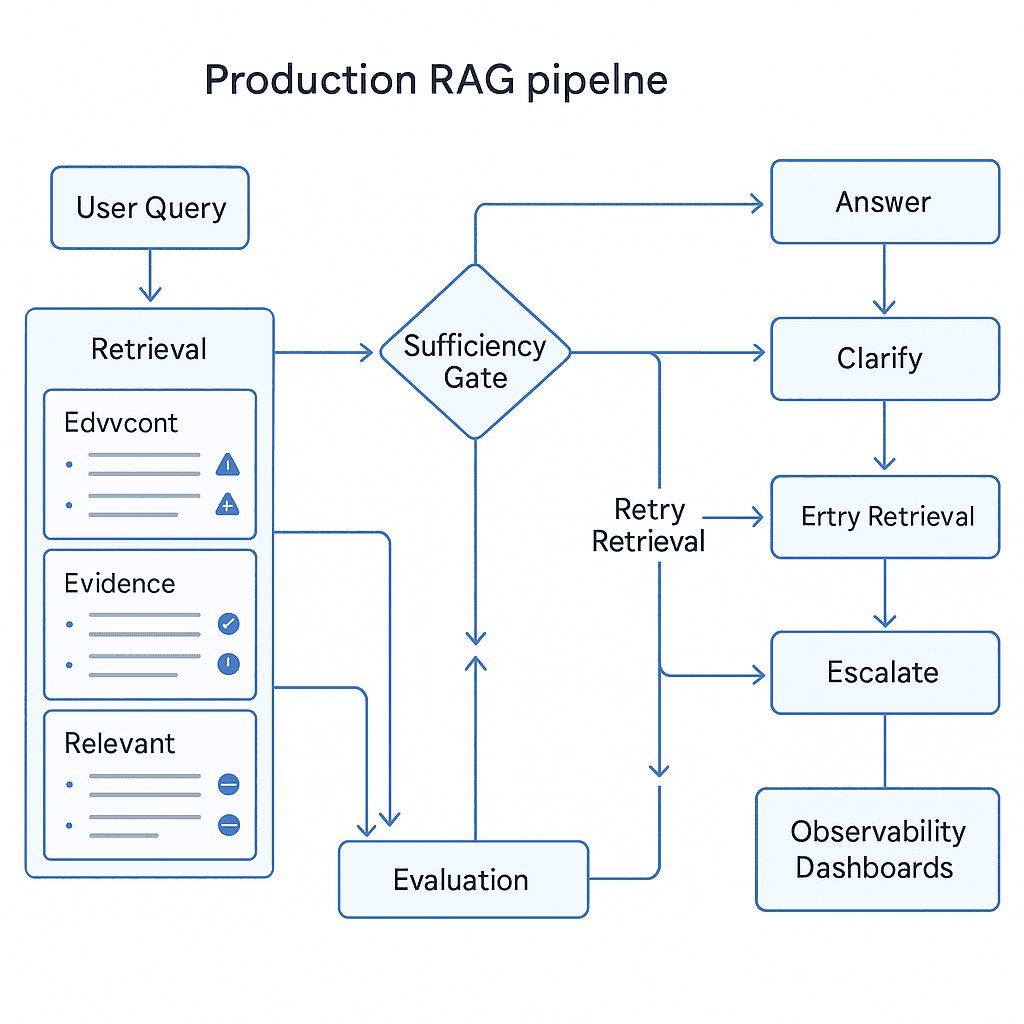
A practical architecture inserts a dedicated gate between retrieval and answer generation.
At a high level:
- Query understanding: classify intent, detect ambiguity, identify entities, date constraints, region/product scope, and whether the task is answerable from the corpus.
- Retrieval and reranking: run one or more retrieval strategies, then rerank.
- Evidence normalization: deduplicate chunks, attach metadata, group by source document/version, and enrich with freshness and authority signals.
- Sufficiency gate: estimate whether the evidence is sufficient and choose an action.
- Action execution:
- answer with citations,
- ask a clarifying question,
- retry retrieval with a reformulated query,
- escalate to a human or fallback system,
- abstain with a helpful explanation.
- Generation: only if the gate allows answering.
- Post-generation verification and observability: optional but recommended.
The key is to make the gate multi-dimensional and action-oriented, not just yes/no.
What the gate should evaluate
In production, I recommend treating sufficiency as a structured assessment over at least six dimensions.
1. Relevance
Do the retrieved passages match the actual user intent, not just keywords?
Signals:
- reranker score distribution,
- semantic overlap between query facets and evidence,
- coverage of required entities, product names, region, plan tier, timeframe,
- whether top evidence addresses the same task type, such as troubleshooting versus pricing versus policy.
2. Coverage/completeness
Do the passages jointly contain all facts needed for a correct answer?
Signals:
- decomposition of the query into required facets,
- facet-to-evidence coverage map,
- presence of required qualifiers like exceptions, prerequisites, limitations,
- whether evidence supports the requested granularity.
A user asking “Can customers in Germany export audit logs on the basic plan?” needs support for geography, product capability, and plan-level constraints. Topical relevance alone is not enough.
3. Consistency
Do the retrieved sources agree?
Signals:
- contradiction detection across evidence snippets,
- version/date mismatches,
- metadata disagreement, such as region or product edition,
- conflicting answer candidates extracted from different documents.
4. Freshness
Is the evidence current enough for the question?
Signals:
- document updated_at,
- policy effective dates,
- release version tags,
- source TTL by content type,
- query sensitivity to freshness.
Not every question needs same-day freshness. Product pricing and policy compliance do; historical architecture docs may not.
5. Authority/trustworthiness
Are the sources authoritative for this question?
Signals:
- source system ranking, such as policy DB over wiki over forum,
- document approval status,
- owner team,
- signed or published artifact versus draft,
- internal versus public source priority.
6. Intent clarity
Is the user request specific enough to answer without making a bad assumption?
Signals:
- multiple plausible interpretations,
- missing identifiers,
- pronouns or underspecified references in multi-turn chat,
- evidence that supports different answers under different assumptions.
These dimensions naturally map to actions.
Action policy: answer, clarify, retry, escalate, abstain
A sufficiency gate becomes valuable when it chooses the next best action instead of merely blocking generation.
Answer
Choose this when relevance, coverage, consistency, freshness, and authority all clear their thresholds and the user intent is sufficiently clear.
Best practice:
- require citation-ready support for each major claim,
- include scoped wording if evidence is narrow,
- optionally expose confidence or support quality internally, not necessarily to users.
Ask a clarifying question
Use when the evidence is adequate for multiple interpretations but the user intent is ambiguous.
Examples:
- “Are you asking about the US or EU policy?”
- “Do you mean SSO for workspace admins or end users?”
- “Which product version are you on?”
This is often better than answering because it preserves user trust and avoids retrieving the wrong branch of documentation.
Retry retrieval
Use when intent is clear but evidence is weak or incomplete and there is a reasonable chance of improving recall/precision.
Retry tactics:
- query rewriting for entity expansion or synonym normalization,
- multi-query retrieval from decomposed sub-questions,
- switching retrieval mode, such as BM25 plus dense plus metadata filtering,
- increasing depth selectively,
- searching document titles/headers separately from chunks,
- using graph or structured lookup if the domain supports it.
Escalate
Use when the system detects conflict among authoritative sources, when the answer has high business risk, or when policy requires human review.
Escalation can mean:
- route to a human agent,
- route to a deterministic business rules engine,
- route to a specialized system of record API,
- present the conflicting sources and ask the user to choose a scope if appropriate.
Abstain
Use when the answer is not in the corpus, the evidence is too weak after retrieval retries, or source trust is inadequate.
Good abstentions are specific and useful:
- say what was searched,
- say what was missing,
- suggest the next best action,
- avoid generic “I don’t know.”
Concrete architecture patterns
There are three implementation patterns I see work in practice.
Pattern 1: Rules-first gate with model assistance
This is the fastest path to production for teams with moderate traffic and a need for predictable behavior.
Pipeline:
- retrieval and reranking produce top-k chunks with metadata,
- deterministic checks run first,
- an LLM judge evaluates nuanced dimensions like completeness or contradiction,
- a policy layer combines signals into an action.
Deterministic checks might include:
- source authority allowlist,
- freshness TTL validation,
- minimum number of distinct supporting documents,
- metadata match for region/product/version,
- exact policy effective date checks,
- unsupported content type or draft content filters.
Then the model judge handles:
- whether the evidence answers the exact question,
- whether any required facet is missing,
- whether the passages disagree,
- what clarification question would resolve ambiguity.
Why this works:
- deterministic checks are cheap and explainable,
- model judgment covers semantic nuance,
- the policy layer remains auditable.
Pattern 2: Learned sufficiency classifier
For higher-scale systems with enough labeled data, train a classifier or ranking model that predicts action or answerability from retrieval outputs and metadata.
Features can include:
- top-k retrieval scores and margins,
- reranker scores,
- source diversity,
- metadata match features,
- freshness deltas,
- contradiction flags,
- query complexity features,
- LLM-extracted coverage features.
Outputs:
- binary sufficient/insufficient,
- multi-class action prediction,
- calibrated probability of supported answering.
This can reduce latency and cost compared with always invoking an LLM judge, but only if you have enough representative data and a process to keep labels current as content and traffic evolve.
Pattern 3: Cascaded gate
This is the pattern I recommend most often.
Stage 1: cheap deterministic filters. Stage 2: lightweight model or small LLM for obvious cases. Stage 3: stronger LLM judge only on borderline or high-risk cases.
Benefits:
- lower average latency and cost,
- stronger quality than pure rules,
- selective use of expensive reasoning where it matters.
A practical cascade might look like:
- if freshness fails or no authoritative source is present, do not answer,
- if top reranked evidence strongly covers all required metadata facets, answer directly for low-risk intents,
- if ambiguous or incomplete, send to a small model judge,
- if the small model is uncertain or detects conflict, send to a larger judge or escalate.
How to design the gate prompt if you use an LLM judge
The gate prompt should not ask for generic “confidence.” Ask for a structured verdict over dimensions and a recommended action.
For example, ask the judge to return:
- intent_summary,
- required_answer_facets,
- relevance_assessment,
- coverage_assessment,
- consistency_assessment,
- freshness_assessment,
- authority_assessment,
- ambiguity_assessment,
- recommended_action,
- rationale,
- supporting_chunk_ids,
- missing_information,
- clarifying_question_if_needed.
This structure matters because it gives you observability and lets you audit why the gate took a given path.
Important prompt design choices:
- provide source metadata, not just text,
- explicitly instruct the model to distinguish unsupported from partially supported,
- ask it to cite chunk IDs for every supported facet,
- forbid it from using world knowledge not present in evidence,
- separate ambiguity from insufficiency.
If you skip these, the judge often collapses distinct failure modes into vague uncertainty.
Query decomposition improves completeness checks
One underused tactic is to decompose the user question into answer requirements before or during gating.
For “What is the SLA for API uptime on the enterprise plan in APAC, and are there exclusions for scheduled maintenance?” the required facets are roughly:
- product/service,
- plan tier,
- region applicability,
- SLA metric,
- exclusion conditions.
Now the gate can ask: which retrieved chunks support each facet? If the exclusion conditions are missing, the context is incomplete even if a top chunk contains the uptime percentage.
This facet coverage framing is far more robust than relying on a single relevance score. It also gives you cleaner labels for evaluation.
Detecting stale and conflicting evidence
Two of the most expensive failure modes in enterprise RAG are stale content and source conflict.
Freshness strategy
Do not treat freshness as a global threshold. Define freshness policies by content class.
Examples:
- pricing pages: 7-day TTL,
- compliance policies: must use latest approved version and effective date,
- troubleshooting docs: 30-day or version-matched,
- evergreen conceptual docs: relaxed TTL.
Implementation details:
- index updated_at, effective_date, release_version, approval_state,
- enrich chunks with parent document metadata,
- maintain source-level trust policies,
- add query classifiers that detect freshness-sensitive intents.
If a freshness-sensitive query retrieves only outdated material, retry retrieval with stronger metadata filters before considering generation.
Conflict strategy
Contradiction can happen even when every document is individually “good.”
Common causes:
- policy changed but old page remains indexed,
- regional variants are mixed,
- docs for adjacent product tiers are retrieved together,
- public and internal docs disagree,
- generated chunk boundaries isolate exceptions from base rules.
Detection tactics:
- group evidence by document/version and compare extracted answer candidates,
- run contradiction detection on top answer-bearing chunks,
- prioritize sources by authority and recency,
- require convergence among top authoritative sources for high-risk intents.
When conflict exists, the correct action is usually not to average across sources. It is to either disambiguate scope or escalate.
Retrieval retry strategies that actually move the needle
If the gate decides context is insufficient but potentially recoverable, your retrieval retry should be deliberate, not just “increase k.”
Useful retry tactics:
Reformulate for missing facets
If coverage analysis shows a missing plan tier, region, or version, append or normalize those constraints explicitly.
Hybrid retrieval
Combine sparse and dense retrieval. Sparse often wins on exact identifiers and policy language; dense helps with paraphrase and semantic intent.
Metadata-filtered retrieval
For enterprise corpora, metadata filters are frequently higher leverage than better embeddings. Restrict by product area, region, doc type, owner team, approval state, or effective version.
Title/section-aware retrieval
Many key constraints live in section headers, tables, or policy appendices that chunk embeddings underweight. Search over titles, headers, and summaries separately.
Sub-question retrieval
Decompose complex questions and retrieve for each sub-question, then merge and rerank evidence.
Deterministic lookups
For known entities like SKU, feature flags, policy IDs, or release versions, hit a structured source directly instead of hoping semantic search finds the right chunk.
In several systems I have seen, adding a retrieval sufficiency gate exposed that the real problem was not generation quality but overreliance on generic vector retrieval where metadata- or API-based lookup should have been used.
Evaluation: how to know the gate is helping
This is where many projects stall. Teams add a gate, see fewer hallucinations in anecdotes, but do not know if they are over-refusing, increasing latency too much, or shifting failure to another stage.
You need an evaluation plan specifically for the gate, not just end-to-end answer quality.
Define the decision labels
At minimum, label examples with:
- sufficient_to_answer: yes/no,
- correct_action: answer / clarify / retry / escalate / abstain,
- failure_mode: weak / incomplete / conflicting / stale / off-intent / ambiguous / out-of-corpus,
- risk_level,
- answer support facets.
This can be done on a stratified sample of production traffic and curated scenarios.
If you only label final answer correctness, you will miss whether the gate chose the right intervention.
Measure gate performance separately from generation
Useful gate metrics:
- precision of “answer” decisions,
- recall of answerable cases,
- false answer rate: cases where gate allowed answering but evidence was insufficient,
- over-refusal rate: cases where gate blocked an answer that would have been supportable,
- clarification utility: fraction of clarify actions that lead to successful resolution,
- retrieval salvage rate: fraction of retry actions that produce sufficient evidence,
- escalation appropriateness,
- abstention helpfulness.
For many organizations, the key business metric is not raw answer rate; it is wrong-answer rate at a given latency/cost budget.
Calibrate by action and risk tier
Threshold calibration should vary by domain risk.
Examples:
- low-risk internal knowledge assistant: tolerate higher answer rate with modest false answers,
- customer support policy bot: lower false answer tolerance,
- compliance or medical workflow: extremely conservative, strong authority and freshness requirements.
Do not use one global threshold across all intents. Use per-intent or per-risk policies.
A practical method:
- score each example with gate signals or judge outputs,
- fit calibrated probabilities if using a learned model,
- choose thresholds per action to optimize an operating point,
- review confusion matrices by intent class and source type.
You may find that “retry retrieval” is beneficial in troubleshooting intents but mostly wasted latency in policy queries, where insufficiency usually means out-of-corpus or missing approval-state metadata.
Build an adversarial evaluation set
Your gate will look better than reality if the eval set over-represents answerable questions. Include hard negatives such as:
- near-match documents from the wrong region,
- superseded versions of the correct policy,
- evidence missing one critical exception,
- mixed sources with conflicting plan tiers,
- ambiguous follow-up turns without antecedents,
- keyword-matching but task-mismatched docs,
- questions whose answers are not in the corpus.
This is where sufficiency gates earn their keep.
Human review rubric
For sampled cases, reviewers should answer:
- Could a correct answer be produced using only the provided evidence?
- If not, what was missing or wrong?
- What should the system have done next?
- If a clarification was needed, what is the minimum useful question?
- If evidence conflicted, which source should win and why?
That last point matters because “conflict” is not enough; your organization needs source precedence rules.
Cost and latency tradeoffs
A sufficiency gate is not free. The point is not to maximize caution at any cost. The point is to reduce expensive wrong answers while preserving throughput and UX.
Think in expected-value terms.
Costs introduced by the gate:
- extra model calls,
- retrieval retries,
- increased tail latency,
- higher abstain/clarify rates.
Benefits:
- fewer hallucinations and policy errors,
- fewer downstream support escalations caused by wrong answers,
- better user trust,
- more interpretable system behavior.
Model choice tradeoffs
Rules only
- lowest cost and latency,
- best explainability,
- weak on nuanced completeness and semantic conflict.
Small LLM or compact classifier
- good for first-pass gating,
- lower cost than a frontier model,
- often enough for relevance, ambiguity, and basic completeness,
- may struggle on subtle contradiction or long evidence sets.
Large frontier model judge
- strongest semantic evaluation,
- best for complex multi-document sufficiency assessment,
- highest cost and latency,
- can still be inconsistent without structured prompts and calibration.
This is why a cascade usually wins in production.
Keep the gate cheap by shrinking the evidence set
Do not send 30 chunks to the judge if only 6 are plausible candidates.
Before judging:
- deduplicate semantically similar chunks,
- merge adjacent chunks from the same source when needed for context,
- rerank aggressively,
- group by source and include summaries,
- trim to evidence likely to bear directly on the answer.
A smaller, cleaner evidence packet improves both cost and accuracy.
Observability: make the gate debuggable
If you cannot see why the gate fired, you cannot improve it.
For each request, log:
- query text and normalized query features,
- retrieval candidates and scores,
- source metadata,
- gate dimension scores or verdicts,
- chosen action,
- latency by stage,
- retry details,
- final outcome,
- user feedback if available.
Dashboards should break down:
- answer/clarify/retry/escalate/abstain rates over time,
- false answer and over-refusal trends,
- failure modes by source type and intent,
- stale-content detections,
- conflict detections,
- retrieval salvage rates,
- latency percentiles by path.
You want to know, for example, whether a spike in abstentions comes from indexing lag, a source-system metadata bug, or an overly aggressive freshness rule.
A particularly useful slice is support gap analysis: which answer facets are most often missing when the gate blocks? That often points to chunking defects, bad metadata, or missing source integrations.
Implementation details that matter more than teams expect
Chunking and metadata quality
Sufficiency gating is only as good as the evidence representation. If chunks lose effective dates, plan tiers, headers, or exception sections, the gate cannot reason reliably about completeness or conflict.
Recommendations:
- carry parent metadata onto each chunk,
- preserve section titles and hierarchy,
- chunk with semantic boundaries where possible,
- keep tables and policy exceptions intact or separately extract them,
- version documents explicitly.
Source precedence policy
Document the authority order for each domain.
Example:
- approved policy DB > system-of-record API > product docs > internal wiki > ticket history > community forum.
When sources disagree, the gate should know which one wins or when to escalate.
Multi-turn conversations
A lot of off-intent and ambiguity failures happen in follow-up turns. The gate should inspect conversation state and whether the necessary referents are resolved.
If the user says “What about on the enterprise plan?” after a prior answer, the gate must know what “what” refers to and whether the retrieved evidence matches the previous scope.
Don’t bury the abstention UX
Users hate dead ends more than caution. If you abstain, be specific.
Bad:
- “I don’t have enough information.”
Better:
- “I found documentation on audit logs, but not plan-specific support for Germany. If you tell me your product edition or allow me to check the current policy source, I can continue.”
High-risk intent routing
Some intents should bypass generic RAG answering entirely unless strict conditions are met. Examples include legal policy interpretation, regulated advice, and actions with financial impact.
Use an intent classifier and route these through stronger source and approval requirements.
A practical rollout plan
If you already have a RAG system in production, do not try to solve every failure mode at once.
Phase 1: Instrument and shadow
- log retrieval outputs and answer citations,
- run a shadow sufficiency judge without affecting user-facing behavior,
- collect disagreement cases between the generator and gate,
- label a stratified sample.
Phase 2: Turn on safe deterministic blocks
Start with high-precision interventions:
- stale source blocks for freshness-sensitive intents,
- authority allowlists,
- explicit conflict blocks for top-risk domains,
- clarifying questions for known ambiguity templates.
Phase 3: Add model-based gating for borderline cases
- use a structured LLM judge or classifier,
- keep thresholds conservative,
- start with low-risk domains or internal traffic.
Phase 4: Enable retrieval retries
- add a limited retry budget,
- measure salvage rate and latency impact,
- disable retry patterns that do not improve answerability.
Phase 5: Calibrate and segment
- set thresholds by intent/risk tier,
- review source-specific error patterns,
- continuously update authority and freshness policies.
This staged approach prevents the common outcome where a team adds a heavyweight gate everywhere, increases latency by 40%, and still cannot explain why answer rates cratered.
An example decision policy
A simple but effective policy might be:
- If intent is high-risk and no approved authoritative source is present: escalate or abstain.
- If query is freshness-sensitive and all candidate evidence is outside TTL: retry with freshness filters; if still stale, abstain.
- If required metadata facets like region/version/plan are unresolved: ask clarifying question if user ambiguity is the cause; otherwise retry retrieval with metadata constraints.
- If top authoritative evidence contains contradictions on answer-bearing claims: escalate or present scoped conflict.
- If all required facets are supported with citation-ready evidence from authoritative current sources: answer.
- If evidence is topically relevant but one or more required facets are unsupported after one retry: abstain.
That policy is not glamorous, but it is legible, operational, and far safer than “let the model decide in the answer prompt.”
What success looks like
When teams implement retrieval sufficiency checks well, the user-visible change is subtle but meaningful. The assistant becomes slightly less eager and much more trustworthy. It asks better questions before answering. It stops confidently stitching together half-evidence. It knows when a policy page is old, when a regional mismatch matters, and when it should hand off rather than bluff.
Operationally, you should expect:
- a drop in unsupported answer rate,
- a modest increase in clarifications and abstentions,
- improved citation quality,
- better debugging of retrieval defects,
- clearer segmentation of “retrieval issue” versus “generation issue,”
- more stable performance as corpora evolve.
The deeper benefit is architectural. You stop treating retrieval and generation as a single magical blob and instead insert a policy-enforced checkpoint between them. That is how production systems become governable.
Takeaways
A retrieval sufficiency gate is one of the highest-leverage additions you can make to a production RAG system once the basics are in place.
The core ideas are straightforward:
- sufficiency is not the same as relevance,
- not every insufficiency should trigger abstention,
- action selection matters as much as detection,
- freshness, authority, and conflict deserve first-class treatment,
- evaluation must measure false answers and over-refusals separately,
- calibration should vary by intent and risk,
- observability is required if you want to improve the system rather than merely constrain it.
If I had to summarize the practitioner lesson in one sentence, it would be this: do not let the generator decide whether the retrieved evidence is good enough. Make that an explicit, measurable, policy-driven decision before generation begins.
That one change often marks the difference between a RAG demo that sounds smart and a RAG product that behaves responsibly under real traffic.