Per-Tenant Retrieval Threshold Tuning in Enterprise RAG: Why One Global Score Cutoff Fails in Production
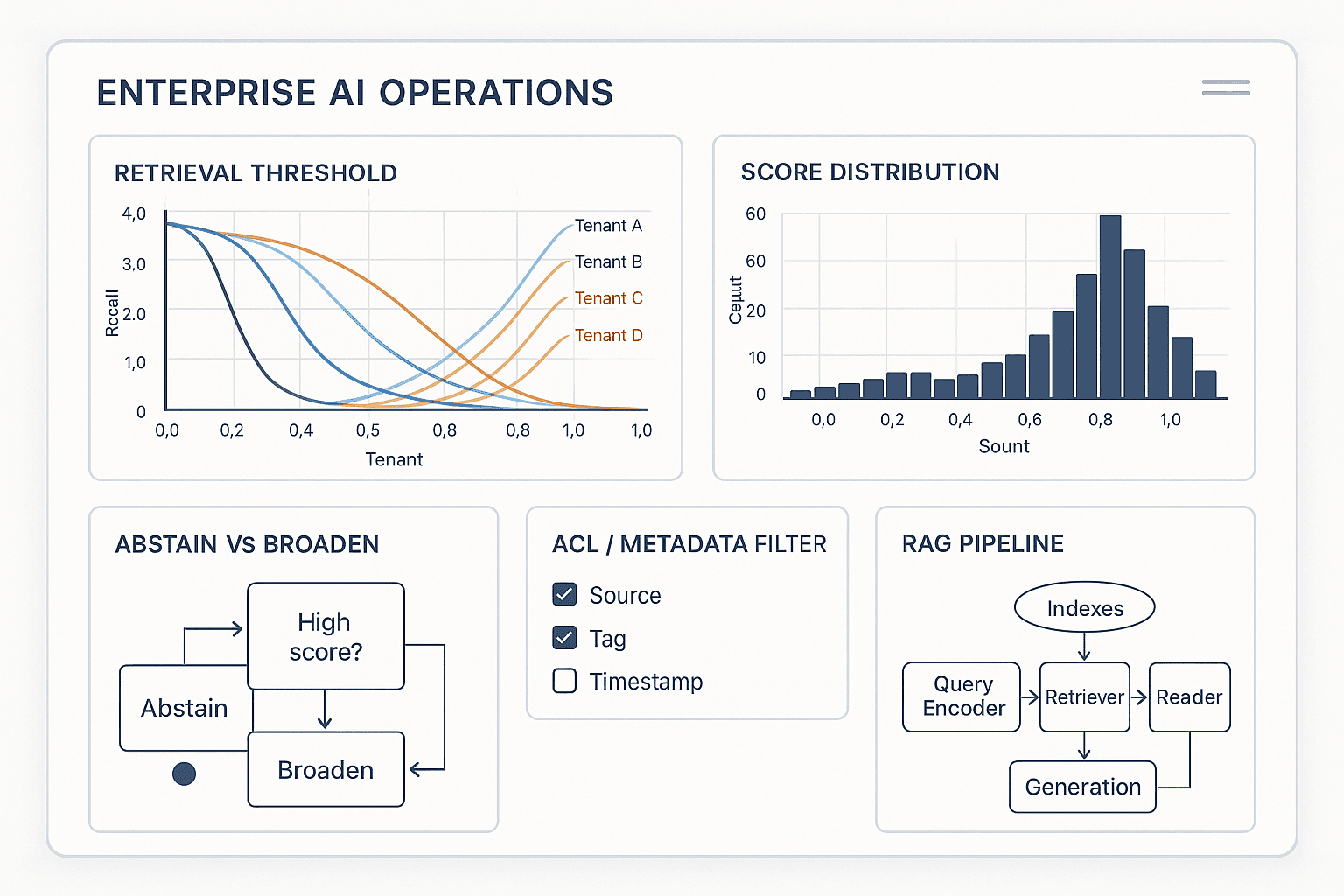
A team ships an enterprise RAG assistant that looks excellent in staging. The benchmark set is small but clean. The retrieval pipeline is standard: hybrid search over chunked documents, a cross-encoder reranker, then an answer model that cites sources. They pick what feels like a reasonable policy: retrieve top 20 candidates, rerank them, keep any result above a reranker score of 0.18, and if fewer than three passages survive, fall back to “top 3 anyway” so the generator has something to work with.
For the first customer, it works surprisingly well.
For the second, answer quality drops, but only for certain departments. HR users get overconfident answers from irrelevant employee handbook snippets. Legal users get too many abstentions even when the answer exists in policy memos. Finance users see answers grounded in stale spreadsheets because current files are permission-restricted and the system quietly substitutes lower-scoring accessible content. The retrieval metrics from the aggregate dashboard still look acceptable. Mean reciprocal rank is decent. Median reranker score barely moved. Leadership asks why customers are reporting hallucinations if “retrieval quality is stable.”
This is the moment many teams discover that a single global retrieval threshold is not a product decision. It is a shortcut. And in enterprise RAG, shortcuts around thresholding fail in production because the score distributions you are thresholding are not stable across tenants, corpora, document types, access-control filters, query classes, and even ingestion maturity.
The practical lesson is simple: relevance scores are local, not universal. A 0.18 reranker score in one tenant may indicate a strong match; in another, it may be pure noise. A cosine similarity of 0.82 over a compact product catalog behaves differently from 0.82 over OCR-heavy PDFs from a post-merger compliance archive. If you run one global cutoff, you are pretending that heterogeneous retrieval systems emit calibrated probabilities. They do not.
The rest of this article is about how to stop pretending and build threshold tuning the way production systems actually need it: per tenant, per corpus family, and often per query class, with explicit abstain-versus-broaden policies, ACL-aware evaluation, observability, release gates, and rollback controls.
The pattern behind the failure
The recurring production pattern looks like this:
- The retrieval stack is shared. Same embedding model, same vector index family, same reranker, same top-k defaults.
- The data is not shared in any meaningful statistical sense. Each tenant has different documents, lengths, writing styles, duplication rates, update freshness, OCR quality, metadata quality, and permission topology.
- Score distributions shift. Dense retrieval, BM25, hybrid fusion, and reranker scores all change shape across those environments.
- A single threshold encodes the wrong tradeoff. It over-admits junk for some tenants and over-rejects relevant passages for others.
- Generation amplifies the problem. If low-quality context gets through, the LLM confidently synthesizes from it. If relevant context is withheld, the model either abstains too often or fills the gap with priors.
Teams often notice this first as a business problem, not an IR problem. One customer complains that the bot is “making things up.” Another says it “never answers straightforward questions.” A third says “answers differ by department.” All three complaints can come from the same root cause: thresholding that assumes score comparability where none exists.
The mistake is understandable because most offline retrieval experiments hide the issue. We compare candidate sets on curated evals, report top-k recall or nDCG, and choose a threshold that looks best globally. But enterprise RAG is a conditional system. Users only see content allowed by ACLs. Metadata filters can shrink the candidate pool by 95%. Corpora differ by age and quality. Query intent changes the right decision boundary. “What is our parental leave policy?” and “Summarize contract risks in this MSA” should not necessarily use the same retrieval acceptance policy.
Why the naive global cutoff fails
There are several distinct reasons the global-score approach breaks.
1. Scores are not calibrated across corpora
Vector similarity scores are notorious for being non-comparable across indexes and data distributions. Even rerankers, though often more stable, are still sensitive to chunk style, passage length, boilerplate prevalence, and domain language.
A reranker score of 0.22 might mean:
- strong relevance in a tenant with concise technical docs,
- weak relevance in a tenant with highly repetitive policy templates,
- middling relevance in a tenant whose chunks contain OCR artifacts and table fragments.
If you set a universal minimum score, you are implicitly assuming the same score has the same precision-recall tradeoff everywhere.
2. Top-k interacts badly with heterogeneous corpora
Global top-k policies fail for opposite reasons in opposite environments.
- In a small, clean corpus, top 10 may be enough and top 50 just adds distractors.
- In a large noisy corpus, top 10 may miss the right evidence entirely, especially if the question uses synonyms, product codenames, or local terminology.
- In ACL-constrained environments, top-k before permissions may look good while top-k after permissions collapses.
What matters is not “retrieve 20” but “how much relevant accessible evidence survives after filtering and ranking?”
3. Metadata and ACL filters distort the score distribution
This is one of the least appreciated production issues.
Suppose your unrestricted retrieval pool contains highly relevant documents scoring in the top range. Once ACL filters remove the user-inaccessible candidates, the remaining accessible set often has a lower score distribution. If you keep the same minimum-score threshold, the system may abstain more often for restricted users than for admins, even when a valid but lower-scoring answer source exists.
The reverse can also happen. In tightly filtered subsets like department=HR and doc_type=policy, the search space becomes much narrower and average scores rise. A threshold calibrated globally may admit many false positives because “everything looks relevant” within a repetitive corpus.
4. Different query classes need different actions when scores are weak
Weak scores do not always mean the same operational response.
For example:
- Navigational lookup: “Where is the travel reimbursement form?” If confidence is low, broaden retrieval or use metadata expansion.
- Policy question: “Can contractors access customer PII?” If evidence is weak, abstain rather than answer from loosely related context.
- Analytical synthesis: “Summarize Q4 escalations affecting product X.” If scores are weak, expanding time range or increasing document diversity may help more than abstention.
A single threshold cannot encode these semantics.
5. Retrieval errors are asymmetric in enterprise settings
Consumer search products can tolerate some irrelevant results. Enterprise assistants often cannot tolerate confidently wrong answers on policy, compliance, legal, security, or financial questions.
That means the right operating point is tenant- and use-case-specific. One tenant may prefer higher abstention if precision is critical; another may prefer broader retrieval and longer answers because users value recall over concision.
The better approach: thresholding as a calibrated control system
The practical replacement for a global cutoff is not “hand-tune per customer forever.” It is a lightweight calibration system with explicit segmentation and operational controls.
The core ideas are:
- Segment score behavior by tenant, corpus family, and query class.
- Build threshold curves from eval data, not intuition.
- Separate actions for weak retrieval: abstain, broaden, reformulate, or escalate.
- Tune on post-filter reality including ACLs and metadata constraints.
- Deploy thresholds like model configs with canaries, release gates, observability, and rollback.
A good mental model is that thresholds are part of your policy layer, not hardcoded constants in your retriever.
A reference architecture for per-tenant threshold tuning
A production architecture usually looks like this:
Online request path
-
Query classification
- Predict query class: factual lookup, policy/compliance, analytical synthesis, document-specific Q&A, etc.
- Detect high-risk domains where precision matters more.
-
Retrieval plan selection
- Choose retrieval recipe by tenant + corpus family + query class.
- Example recipe includes:
- candidate generators: BM25, dense, hybrid
- initial top-k per generator
- metadata filter strategy
- reranker model
- score thresholds and fallback actions
-
Candidate retrieval
- Execute retrieval under ACL and metadata constraints.
- Capture both pre-filter and post-filter candidate statistics.
-
Reranking
- Score candidates using a cross-encoder or late-interaction reranker.
-
Decision policy
- If score profile exceeds threshold for this segment, pass context to generation.
- If borderline, trigger broadening, query rewrite, or diversity expansion.
- If below safety threshold, abstain or ask a clarifying question.
-
Answer generation
- Prompt the LLM with only accepted evidence.
- Include answer style and citation requirements tied to risk level.
-
Logging and observability
- Log segment identifier, score histograms, threshold used, action taken, and outcome signals.
Offline calibration path
- Build tenant-aware eval sets.
- Run retrieval and reranking with ACL simulation.
- Generate threshold curves per segment.
- Choose operating points by business objective.
- Validate against guardrail metrics.
- Promote threshold configs through release stages.
This can be implemented without changing your entire stack. The biggest change is conceptual: move from one hardcoded min_score to a versioned threshold policy service.
What to segment on
In theory you could tune thresholds for every tenant and every intent separately. In practice, data sparsity and operational complexity matter. Start with the segmentation variables that create the biggest score shifts.
Tenant
This is the most obvious one. Different tenants have different content quality, taxonomy discipline, and permission structures. Even if you eventually cluster tenants into archetypes, begin by measuring per-tenant variance before assuming shared thresholds.
Corpus family
Within a tenant, score behavior often differs sharply across corpora:
- policies and handbooks
- tickets and case notes
- wikis and engineering docs
- contracts and legal files
- spreadsheets and BI exports
- scanned PDFs / OCR content
A cross-encoder score on a clean wiki chunk should not necessarily be judged by the same line as a score on an OCR’d contract exhibit.
Query class
At minimum, separate:
- exact/navigational lookup
- factoid Q&A
- policy/compliance
- summarization/synthesis
- document-specific interrogation
If you support multiple languages or heavily domain-specific jargon, those can merit their own segments too.
Filter regime
This is frequently overlooked. You may need separate threshold behavior for:
- unrestricted internal admins
- normal end users with ACL constraints
- strongly filtered queries such as
product=X,region=EU,date<90d
The narrower the filter, the less reliable global score assumptions become.
How to build threshold curves from eval data
Threshold tuning should be data-backed, but the right data is not just a pile of labeled query-document pairs. You need evaluation that reflects the actual serving environment.
Step 1: create segment-aware eval sets
For each segment, collect queries with:
- user question
- tenant and corpus identifiers
- realistic ACL context
- metadata filters that would have applied in production
- one or more relevant answer passages or documents
- optionally an expected abstain label when no accessible answer exists
This last category matters. In enterprise systems, “no accessible answer” is a first-class outcome, not a failure of the eval set.
You do not need perfect labels to start. A pragmatic process is:
- mine support tickets and search logs,
- sample failed and successful production traces,
- have SMEs label top retrieved results as sufficient / partial / irrelevant,
- generate hard negatives from semantically similar but wrong documents.
Aim for a mix of easy, medium, and adversarial queries. If all your evals are cleanly phrased questions with obvious gold documents, your thresholds will be too permissive in production.
Step 2: evaluate the full retrieval chain
Do not calibrate thresholds on raw vector similarity alone if your production system uses hybrid retrieval plus reranking. Measure at the exact point where the threshold is applied.
For each query and segment, record:
- top-k candidate set before filters
- top-k after ACL/metadata filters
- reranker scores for candidates
- whether at least one candidate is truly sufficient
- rank of first sufficient candidate
- max score, score gap, score slope, and number of candidates above score bands
The raw threshold often performs better when combined with secondary features such as score gap between rank 1 and rank 2, or proportion of candidates above a soft floor.
Step 3: generate threshold-performance curves
For each segment, sweep thresholds and compute metrics such as:
- precision of accepted contexts
- recall of answerable queries
- abstention rate
- false-answer risk rate
- retrieval coverage after ACLs
- downstream answer faithfulness / citation correctness
A simple but effective graph is:
- x-axis: threshold
- y-axis: precision, recall, and abstain rate
Do this per tenant or per cluster. The curves often make the argument for per-tenant tuning immediately obvious. Some tenants will have steep precision gains with modest recall loss; others will lose recall catastrophically with almost no precision benefit.
Step 4: choose operating points by business objective
There is no universally correct threshold. There is a correct threshold for a product objective.
Examples:
- Compliance assistant: optimize for low false-positive answer rate even if abstentions rise.
- Internal knowledge assistant: optimize for answer coverage while keeping hallucination risk under a defined ceiling.
- Case management copilot: optimize for sufficient evidence recall at top 5 because analysts can inspect citations manually.
A useful operating policy is to define hard guardrails first, then optimize utility beneath them. For example:
- false grounded-answer rate < 1.5%
- citation mismatch < 2%
- answerable-query abstention < 18%
Then pick the highest-coverage threshold satisfying those constraints per segment.
Abstain versus broaden retrieval
Low confidence should not automatically mean “say I don’t know.” Often the best move is one more retrieval step.
The key is to make this a policy decision based on query class and score profile.
When to abstain
Prefer abstention when:
- the query is high-risk: legal, compliance, HR, security, finance
- the top score is below the segment’s safety floor
- score gaps are flat, suggesting diffuse relevance
- retrieved evidence is contradictory or stale
- ACL filtering removed the likely gold results and no sufficient accessible source remains
In these cases, broadening retrieval may only increase distractors and give the generator more chances to confabulate.
When to broaden
Prefer broadening when:
- the query is navigational or lookup-oriented
- the user phrasing likely mismatches document terminology
- filters are probably too narrow
- top scores are close to threshold and candidate diversity is low
- corpus type historically benefits from wider lexical retrieval or query expansion
Broadening tactics include:
- increasing top-k for one retrieval round
- adding BM25 if dense-only was used
- adding dense if lexical-only was used
- query rewriting with synonym expansion or acronym expansion
- relaxing non-essential metadata filters
- retrieving at document level before chunking locally
- increasing diversity constraints across sources
A practical policy ladder
One robust pattern is a three-zone threshold policy:
- Accept zone: top reranker score >= segment accept threshold and at least one sufficient citation pattern exists.
- Recovery zone: score falls between broaden threshold and accept threshold; trigger one recovery action.
- Abstain zone: score below broaden threshold or query class is high-risk with weak evidence.
This avoids binary thinking. Many systems improve substantially just by treating the “gray zone” as a chance for retrieval recovery instead of forcing either a risky answer or an unnecessary abstention.
Why ACLs and metadata filters require separate calibration
Access control is not just an authorization concern. It changes retrieval behavior.
Imagine two users ask the same question. One is an admin with access to recent board materials; the other is a manager without access to those files. The retriever finds highly relevant admin-only passages. After ACL filtering for the manager, the remaining candidates are lower-scoring and maybe only indirectly relevant. If your threshold does not account for this, you will either:
- answer from weaker evidence, increasing hallucination risk, or
- abstain despite accessible partial answers existing elsewhere.
To handle this properly:
- Run evals under user-realistic ACL views. Do not calibrate only with unrestricted service-account access.
- Measure pre-filter and post-filter score shift. Large drops indicate ACL-sensitive segments.
- Track accessible-answer availability. Distinguish “answer exists globally” from “answer exists for this user.”
- Tune thresholds post-filter. The serving decision is based on what the user can see, not the global corpus.
- Consider alternate actions when ACLs suppress gold evidence. For example: “I found related information, but I may not have access to the authoritative source. Here are the accessible documents I can cite.”
Metadata filters have similar effects. If you force region=EMEA and doc_type=policy, the retriever sees a compressed world with very different score dynamics than the global corpus. Thresholds should be calibrated on those filtered slices when they are common enough to matter.
Model and tool choices: what changes threshold behavior
Thresholding quality depends heavily on the retrieval and reranking stack.
Dense retrievers
Dense retrieval is good for semantic matching and paraphrases, but embedding spaces are rarely score-calibrated across domains. If you use one embedding model across very different enterprise corpora, expect threshold drift.
Tradeoffs:
- Pros: good semantic recall, useful for vocabulary mismatch
- Cons: score comparability is weak; can over-retrieve semantically adjacent but policy-irrelevant text
- Operational implication: avoid using dense similarity score alone as a global acceptance criterion
BM25 / lexical retrieval
Lexical methods are often more stable for exact terminology, IDs, policy names, and product codenames. They also behave better when corpora contain sparse but precise anchors.
Tradeoffs:
- Pros: strong precision for exact terms, transparent failure modes
- Cons: poor on paraphrases and conceptual questions
- Operational implication: thresholds based on lexical rank or score can still vary by corpus size and tokenization quality, but often less unpredictably than dense similarity
Hybrid retrieval
Hybrid is usually the best default in enterprise systems because tenants vary so much. But hybrid fusion complicates thresholding because fused scores may not be inherently interpretable.
Operational implication: threshold after reranking, not on fused retrieval score, unless your fusion method is explicitly calibrated.
Cross-encoder rerankers
These are often the most useful threshold point because they score query-passage relevance more directly. Still, they are not magically universal.
Tradeoffs:
- Pros: best relevance discrimination in many enterprise pipelines
- Cons: latency and cost increase with candidate count; scores still domain-sensitive
- Operational implication: use reranker score as primary threshold signal, but calibrate per segment
Late-interaction models
Models like ColBERT-style retrieval can improve first-stage quality and reduce dependence on a heavy reranker, but they add indexing complexity.
Operational implication: if you switch retrieval architecture, re-calibrate thresholds. Do not carry forward the previous operating points.
Cost and latency tradeoffs in threshold tuning
Per-tenant tuning sounds expensive. It can be, if you overengineer it. But the practical cost is usually modest relative to the downstream cost of bad answers.
Where the cost comes from
- collecting and labeling eval data
- maintaining segment configs
- running threshold sweeps offline
- broader retrieval or larger rerank candidate sets in recovery paths
- observability storage for score distributions and decision traces
Where the savings come from
- fewer irrelevant passages sent to the generator, lowering token cost
- fewer retries caused by poor initial grounding
- reduced support escalations from hallucinations
- lower need for brute-force top-k inflation everywhere
A sensible latency budget pattern
Use a two-tier retrieval strategy:
- Fast path: normal candidate set and reranking, with segment-specific threshold
- Recovery path: only when scores fall in the gray zone, do one extra retrieval or rewrite step
This keeps median latency low while spending extra compute only on ambiguous requests.
For example:
- first-stage hybrid retrieve 20, rerank 20
- if top score >= accept threshold, proceed
- if in recovery zone, retrieve 50 with expansion and rerank top 30
- if still weak, abstain
Compared with globally retrieving and reranking 50 for every request, this often improves both cost and quality.
Implementation details that matter in real systems
1. Store thresholds as versioned policy configs
Do not bury thresholds in code. Create a config object keyed by segment:
- tenant or tenant cluster
- corpus family
- query class
- filter regime if relevant
- retriever/reranker model version
- accept threshold
- broaden threshold
- fallback strategy
- risk tier
Version this config and roll it out like any other production dependency.
2. Include model/version bindings
Thresholds are only meaningful relative to a specific retrieval stack. If you upgrade embeddings, chunking, reranker, OCR pipeline, or metadata normalization, expect score drift.
Every threshold policy should declare the retrieval stack versions it was calibrated against.
3. Log the right features for later recalibration
At minimum, log:
- segment id
- query text hash and query class
- retrieval filters applied
- candidate counts pre/post ACL
- top scores and score gaps
- selected action: accept, broaden, abstain
- citations used in answer
- user feedback if available
- downstream evaluator outputs: faithfulness, citation support, answer quality
Without this, you cannot tell whether threshold failures come from retrieval, permissions, or generation.
4. Add release gates before promoting new thresholds
A threshold change can be as impactful as a model change. Gate it.
Good release checks include:
- no regression on high-risk query classes
- false grounded-answer rate within guardrail
- abstention increase within allowed range
- tenant-specific canary metrics stable for 24–72 hours
- no significant ACL-related accessible-answer drop
5. Build rollback controls
When a threshold policy underperforms, rollback should be immediate and boring.
Use:
- config version pinning
- canary percentage rollout
- per-tenant override kill switch
- automatic rollback on guardrail breach
Do not require code redeploys to revert threshold configs.
An evaluation strategy that actually reflects production
A lot of teams tune thresholds using retrieval-only metrics and then wonder why answer quality still moves unpredictably. Thresholds sit at the boundary between retrieval and generation, so your eval stack has to connect both.
Layer 1: retrieval sufficiency
Measure whether accepted contexts contain enough evidence to answer.
Metrics:
- sufficient-context precision
- sufficient-context recall
- accessible-answer recall
- false accept rate on non-answerable queries
Layer 2: answer grounding
Given accepted contexts, does the model answer faithfully?
Metrics:
- citation support rate
- faithfulness / entailment score
- answer refusal appropriateness
- contradiction rate across citations
Layer 3: business outcome slices
Measure by segment and risk tier:
- policy question accuracy
- time-to-answer for analysts
- support deflection quality
- user trust or re-query rate
Thresholds that look good on aggregate answer quality can still be bad if they fail one critical tenant or one sensitive use case.
A concrete rollout plan
If your system currently uses one global threshold, here is a pragmatic migration path.
Phase 1: instrument and measure
- Keep current behavior.
- Start logging score distributions by tenant, corpus family, and query class.
- Add ACL-aware candidate stats.
- Build a small eval set for your top 5 tenants or most important internal business units.
Goal: prove variance exists and find the biggest failure segments.
Phase 2: add a threshold policy layer
- Externalize thresholds into config.
- Support segment lookup and fallback inheritance.
- Implement accept / recovery / abstain zones.
Goal: stop hardcoding one min_score everywhere.
Phase 3: calibrate high-impact segments
- Tune thresholds for the tenants and query classes with the clearest pain.
- Focus first on high-risk policy/compliance and high-volume knowledge lookup.
- Add one recovery tactic, not five.
Goal: get quality improvement with manageable complexity.
Phase 4: operationalize
- Add release gates, canaries, and rollback.
- Monitor segment drift weekly.
- Recalibrate after major ingestion or model changes.
Goal: make thresholding part of normal production operations.
Common mistakes to avoid
Mistake 1: tuning only on aggregate metrics
Aggregate curves hide the exact problem per-tenant tuning is meant to solve. Always inspect slices.
Mistake 2: tuning with service-account access
If your eval runner has broad access but users do not, your thresholds will be miscalibrated from day one.
Mistake 3: using only top-1 score
Top score alone is often too brittle. Score gap, candidate diversity, and post-filter candidate count are useful secondary signals.
Mistake 4: broadening retrieval without limit
Recovery paths can degrade into expensive distractor generation. Cap the number of recovery attempts and prefer one meaningful expansion over repeated retries.
Mistake 5: forgetting that ingestion changes scores
OCR improvements, chunking changes, deduplication, metadata cleanup, and reranker upgrades can all shift score distributions. Treat them as recalibration events.
What “good” looks like in production
A mature enterprise RAG system usually has the following properties:
- thresholds are configurable, versioned, and segment-aware
- retrieval decisions account for tenant, corpus family, query class, and ACL/filter regime
- weak scores trigger explicit recovery or abstain behavior, not accidental defaults
- evals include accessible-answer scenarios and no-answer scenarios
- dashboards show score distributions and acceptance rates by segment
- threshold changes have canaries, release gates, and rollback
- model or ingestion changes automatically trigger recalibration checks
At that point, threshold tuning stops being an ad hoc relevance hack and becomes what it really is: a control mechanism for answer risk.
The main takeaway
One global score cutoff fails in enterprise RAG because enterprise retrieval is not one problem. It is a federation of problems sharing infrastructure.
Different tenants have different corpora. Different corpora produce different score distributions. ACLs and metadata filters reshape those distributions again. Different query classes require different fallback actions. And the cost of being wrong is not uniform.
So the production question is not, “What minimum score should we use?”
It is:
- for this tenant,
- over this corpus family,
- under these access constraints,
- for this query class,
- with this retrieval stack,
- what score regime justifies answering,
- what regime deserves one more retrieval attempt,
- and what regime requires abstention?
Once you frame thresholding that way, the path forward becomes much clearer. Build segment-aware evals. Calibrate on post-filter results. Use threshold curves to pick operating points tied to business risk. Externalize the policy. Instrument it. Roll it out carefully. And expect to revisit it whenever your data, permissions, or models change.
That is more work than picking a global 0.18 cutoff.
It is also the difference between a demo that seems fine and a production system that enterprises can trust.