Designing Semantic Diff Tests for Prompt and Retrieval Changes in Production GenAI
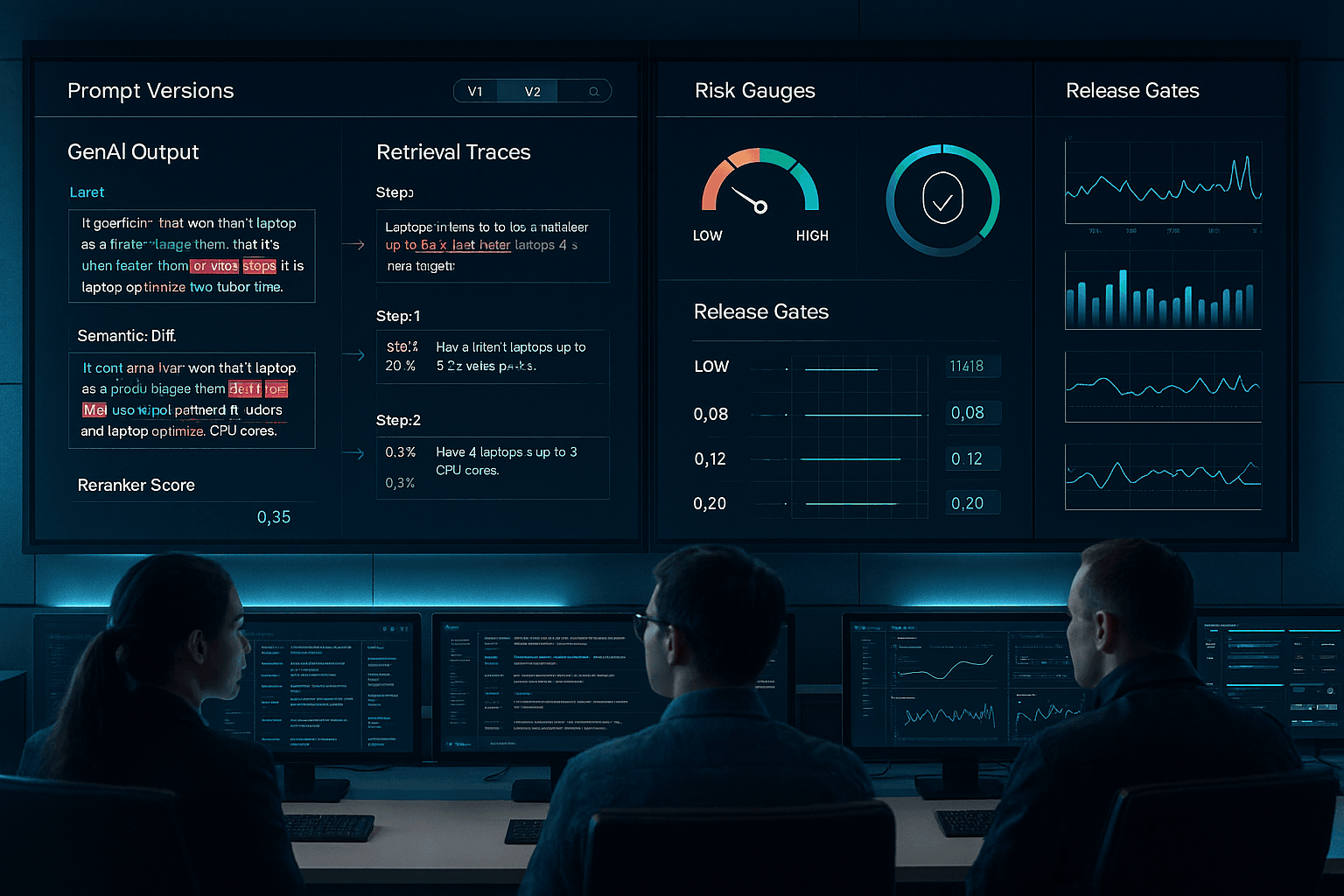
Most GenAI regressions do not look like traditional software regressions.
Nothing crashes. Latency might even improve. Your aggregate eval score may stay flat or go up. The rollout dashboard looks healthy. And then support tickets start arriving: the assistant is suddenly less careful with contract language, the support copilot cites the wrong refund policy in edge cases, or the research agent stops surfacing the one document legal actually cares about.
If you inspect the change that caused it, it often looks harmless:
- a prompt refactor to “reduce verbosity”
- a retrieval tweak from top-k 8 to top-k 20
- a reranker swap that improved offline NDCG
- a context packing change to save tokens
- a safety instruction moved higher in the system prompt
- a chunking update that boosted retrieval recall in benchmark data
The naive instinct is to ask, “Did our tests pass?” But in production GenAI systems, a binary pass/fail eval suite is rarely enough. Many failures are semantic deltas: the new version still answers, still uses the right format, still avoids obvious hallucinations, but changes meaning in a way that matters operationally. It becomes more assertive where the previous version was hedged. It drops one crucial qualification. It answers from a different source. It prefers a cheaper but less authoritative document. It omits the caveat that kept you out of trouble.
This is where semantic diff testing becomes essential.
Semantic diff tests do not ask only whether the candidate output is “good enough” in isolation. They ask whether the candidate meaningfully changed behavior relative to the current production baseline, and whether that change is acceptable for the specific risk profile of your application.
That sounds subtle, but in practice it leads to a very concrete testing discipline:
- replay real production traces
- compare old vs. new end-to-end behavior
- inspect retrieval and context assembly, not just final answers
- adjudicate pairwise differences for correctness, risk, and user impact
- weight regressions by traffic and business criticality
- use release gates based on semantic risk, not only average scores
If you run a production RAG system, agent workflow, or enterprise assistant, semantic diff testing should become part of your release process in the same way schema migration checks and canary analysis are part of conventional backend deployment.
A real failure pattern: “everything got better except the thing that mattered”
Consider a support copilot used by human agents handling subscription billing issues. The team makes three changes in one sprint:
- They rewrite the answer prompt to make responses shorter.
- They replace a cross-encoder reranker with a faster bi-encoder reranker to cut latency.
- They change context assembly to include more snippets from recent policy updates.
Offline, the metrics look promising:
- latency down 28%
- cost per request down 19%
- answer relevance judged in isolation up slightly
- retrieval recall on a benchmark set up 6%
The candidate seems clearly better.
Then a semantic diff review on replayed traces surfaces a pattern. In tricky refund cases, the old system frequently answered with a qualified recommendation like:
Refund may be available if the plan was renewed within 14 days and no premium usage occurred. Verify the account’s usage status before confirming eligibility.
The new system more often says:
The customer is eligible for a refund within 14 days of renewal.
If you grade the new answer in isolation, some evaluators may still mark it as acceptable because it is broadly aligned with policy. But compared with the baseline, the candidate dropped a critical condition. That is a meaning-changing regression. It increases operational risk even though the answer looks cleaner and more decisive.
Tracing backward shows why:
- the faster reranker favored a concise FAQ over the full policy document
- context packing included the refund window but truncated the usage exception
- the shorter answer prompt reduced hedging and qualification language
No single component “failed.” The system behavior changed through interaction effects across retrieval, packing, and generation. Traditional evals often miss exactly this class of issue because they optimize isolated quality rather than differential behavioral safety.
This is the core production lesson: GenAI changes must be tested as behavioral diffs across the full pipeline, not only as isolated prompt or model upgrades.
What semantic diff testing actually is
Semantic diff testing is a release validation approach that compares a baseline production configuration against a candidate configuration on the same trace set, then evaluates the differences in behavior, meaning, provenance, and risk.
The unit under test is usually not just the prompt. It is the end-to-end execution path:
- input normalization
- query rewriting
- retrieval policy
- filters
- reranking
- chunking
- context assembly
- prompt construction
- model choice
- tool call policy
- final answer generation
A semantic diff framework usually answers four separate questions:
- Did the final answer meaningfully change?
- Did the evidence set or provenance change?
- Did the confidence, hedging, or actionability change?
- Does the change increase or decrease business risk?
These are different from conventional metrics.
For example:
- exact string match is too brittle
- “judge this answer 1–5” is too coarse
- aggregate correctness may hide tail-risk regressions
- retrieval recall alone does not tell you whether the right evidence survives packing
- final-answer scoring alone does not reveal provenance degradation
Semantic diff testing sits between micro-level unit tests and macro-level production canaries. It is most useful in pre-rollout validation, where you want to know not just whether the candidate is good, but whether it changed the system in ways you do or do not want.
Why the naive approach fails
Teams usually start with one of four incomplete approaches.
1. String diffs on prompts
You diff the prompt text in Git, review it, and assume the impact is understandable from the wording.
This fails because prompt semantics are non-linear. A tiny wording change can shift:
- extraction vs. synthesis behavior
- deference to retrieved context
- likelihood of refusing
- verbosity and confidence calibration
- tool usage frequency
- conflict resolution between system and retrieved instructions
A two-line prompt diff tells you almost nothing about end-user behavioral change.
2. Pass/fail eval suites
You run an eval set and compare average score before and after.
This fails because averages compress away the exact information you need. If 95 cases improve slightly and 5 high-risk cases regress badly, your mean score may still go up. In production, those 5 cases can dominate user trust or compliance exposure.
3. Retrieval benchmarks in isolation
You compare recall@k, MRR, NDCG, or reranker accuracy.
These are useful but incomplete. In production RAG, the retrieved set is only one stage. The model only sees what survives:
- deduplication
- snippet truncation
- context budgeting
- ordering
- separator formatting
- prompt instructions about evidence use
A retrieval policy can improve top-k relevance but worsen end answers if the packed context becomes noisier or critical details are truncated.
4. Human spot checks without structure
A few people eyeball side-by-side outputs.
This is better than nothing, but it does not scale, is inconsistent, and rarely captures trace-level details. Without structured adjudication criteria and risk labels, you get anecdotes rather than release-quality evidence.
The better approach: semantic diff as a production release primitive
A strong semantic diff system has five layers:
- Trace capture from production or realistic staging traffic
- Replay harness that can execute baseline and candidate pipelines deterministically enough for comparison
- Pairwise adjudication on outputs and intermediate artifacts
- Risk scoring that weights differences by severity and traffic impact
- Release gates that determine whether the change can ship, canary, or must be blocked
A useful mental model is to treat semantic diffing like regression testing plus observability plus human-in-the-loop QA.
Reference architecture
A practical architecture looks like this:
textProduction Traffic
  -> Trace Logger
      - user input
      - metadata / segment
      - retrieval query
      - retrieved candidates
      - reranker scores
      - packed context
      - prompt version
      - model/tool config
      - output
      - tool traces / citations

Trace Store
  -> Sampling + Stratification Layer
      - high-volume common cases
      - rare edge cases
      - policy-sensitive slices
      - recent incidents

Replay Orchestrator
  -> Baseline Runner
  -> Candidate Runner
      - same trace input
      - versioned pipeline configs
      - deterministic settings where possible

Diff Engine
  -> Retrieval Diff
  -> Context Diff
  -> Output Semantic Diff
  -> Citation/Provenance Diff
  -> Latency/Cost Diff

Adjudication Layer
  -> model-as-judge pairwise rubric
  -> heuristic checks
  -> human review queue for high-risk deltas

Risk Scoring + Gates
  -> severity * exposure * confidence
  -> rollout recommendation
  -> ship / canary / block
This architecture matters because it avoids the common mistake of evaluating only final text. Many production regressions are obvious if you inspect the trace:
- the candidate stopped retrieving policy PDFs and now prefers stale help-center summaries
- the reranker stopped surfacing long documents with nuanced exclusions
- context packing now drops footnotes that carry the key exception
- the new prompt references “use the most relevant snippets” and the model ignores lower-ranked but required evidence
If you only compare final answers, you miss the root cause and often cannot fix the issue efficiently.
Build the right trace set: replay is only as good as the examples
Semantic diffing starts with trace quality.
If your replay set is 500 randomly sampled easy queries, you will learn very little. Production failures cluster in the tails:
- ambiguous questions
- policy edge cases
- long-tail entities
- conflicting documents
- multi-turn carryover cases
- tool failures
- low-quality OCR or semi-structured docs
- adversarial user phrasing
A robust replay corpus should mix several sources.
1. High-volume representative traffic
This captures overall behavior, cost, and latency impact.
2. High-risk slices
Examples:
- legal, finance, healthcare, HR
- refund, cancellation, eligibility, compliance workflows
- escalation recommendations
- anything that triggers external actions
3. Incident-driven examples
Every support escalation or postmortem should feed the replay bank.
4. Synthetic perturbations
Create controlled variants:
- paraphrases
- missing-entity variants
- contradictory context variants
- longer conversational history
- harder retrieval distractors
5. Boundary and failure traces
Explicitly include:
- empty retrieval
- partial tool failure
- stale docs
- duplicated chunks
- token-budget overflow
- conflicting sources of different authority
In practice, teams do best with a stratified replay set where each trace has metadata tags like:
- product area
- user segment
- risk class
- expected evidence authority
- conversation length
- retrieval difficulty
- tool dependency
These tags become vital when you interpret regressions. A 2% regression in low-risk FAQ traffic is not equivalent to a 2% regression in refund eligibility advice.
Pairwise adjudication: compare old vs. new, not just absolute quality
The heart of semantic diff testing is pairwise adjudication.
Instead of asking, “Is the candidate answer good?” ask:
- Which answer is more correct?
- Which answer is better supported by the retrieved evidence?
- Did the candidate omit or add material conditions?
- Is the candidate more or less actionable?
- Is the candidate more or less risky if followed literally?
- Did provenance quality improve or worsen?
Why pairwise works better
Humans and judge models are often more reliable at comparing two outputs than assigning absolute scores. Relative judgments reduce scale inconsistency and force attention onto change, which is what matters in a release decision.
A practical adjudication rubric
For each baseline/candidate pair, score the following dimensions:
-
Semantic equivalence
- equivalent
- minor wording change
- meaningfully different
-
Correctness vs. trusted reference/evidence
- baseline better
- candidate better
- tie
- both flawed
-
Evidence support
- candidate better grounded
- same grounding
- candidate less grounded
-
Risk delta
- candidate lower risk
- no material change
- candidate higher risk
-
User impact
- negligible
- noticeable but acceptable
- harmful/confusing
-
Change type
- omitted condition
- incorrect specificity
- citation/source downgrade
- overconfident language
- instruction-following improvement
- better refusal
- verbosity only
You can implement this with a judge model plus deterministic checks and human review on disputed or high-risk samples.
Judge model prompt pattern
A good judge prompt should include:
- the user query
- conversation context
- retrieved documents and their authority ranking
- baseline answer
- candidate answer
- clear rubric
- instruction to focus on factual and operational differences, not style preference
- requirement to quote evidence supporting the judgment
For example, the judge should be told to identify whether the candidate dropped qualifiers like “if,” “unless,” “subject to,” “verify,” or “based on current records.” Those words often carry most of the operational safety.
Important warning: do not trust a single judge blindly
Judge models are useful, but they also drift and have their own biases. A production-grade semantic diff system should combine:
- one or more LLM judges
- rule-based detectors
- metadata heuristics
- human review for high-severity cases
Think of model-as-judge as a triage layer, not the sole source of truth.
Retrieval diffs matter as much as output diffs
Many teams focus too much on final answer text. In RAG systems, the deeper question is often whether the model saw the right evidence.
You want explicit retrieval and context diffs.
Retrieval diff checks
For each trace, compare baseline vs. candidate on:
- retrieved document IDs
- source authority mix
- rank position changes for trusted sources
- freshness/version of documents
- score margins between relevant and distractor docs
- top-k overlap and divergence
Useful metrics include:
- Jaccard overlap on retrieved doc IDs
- authority-weighted overlap
- rank-biased overlap
- presence/absence of must-have docs
- proportion of context budget consumed by low-authority snippets
Context assembly diff checks
This is where many hidden regressions occur.
Compare:
- total token budget used
- number of chunks included
- truncation points
- order of snippets
- whether critical exceptions survived packing
- duplication rate
- separator and metadata formatting
- conversation-history vs. evidence allocation
A simple but powerful test is critical span retention: define spans or fields in authoritative docs that must survive into the final packed context for certain query classes. If a candidate retrieval or packing policy drops those spans, treat that as a structural regression even before you score the final answer.
Example:
- query class: refund eligibility
- critical span: exclusion for premium feature usage after renewal
- baseline packed context: includes exclusion
- candidate packed context: exclusion truncated
That should immediately elevate risk.
The semantic diff pipeline in practice
Here is a concrete implementation pattern that works well.
Step 1: Version every component that changes behavior
At minimum, version:
- system prompt
- developer/task prompt
- retrieval config
- query rewrite prompt/model
- reranker type/version
- chunking policy
- packing policy
- citation formatter
- answer model and parameters
- tool selection policy
Do not rely on “current config” lookups during replay. You need immutable candidate and baseline specs.
Step 2: Capture end-to-end traces with intermediate artifacts
Store enough detail to reconstruct behavior:
- raw user input
- normalized input
- conversation history snapshot
- rewritten query
- retrieval candidates with scores
- reranked order with scores
- packed context text and document references
- final prompt payload
- tool calls and results
- final answer
- citations
- latency and token usage per stage
Without intermediate artifacts, you will not be able to locate why a semantic delta happened.
Step 3: Re-run both configs on the same trace set
Where possible, reduce variance:
- set temperature low or fixed
- control random seeds if the provider supports it
- freeze external tool responses when replaying
- snapshot document corpora and indexes
- pin model versions
Perfect determinism is not always possible, especially with hosted APIs, but you can still get useful comparative results if you minimize moving parts.
Step 4: Compute layered diffs
For each trace, produce:
- output diff summary
- retrieval set diff summary
- context packing diff summary
- citation/source diff summary
- latency and cost delta
- judge verdicts with rationale
- heuristic flags
Step 5: Assign a risk score
A practical risk formula:
textRisk Score = Severity × Exposure × Confidence
Where:
- Severity = how harmful the semantic change would be if followed
- Exposure = how often this pattern is likely to occur in real traffic
- Confidence = how confident you are that this is a true regression
You can refine this with authority and business value terms:
textRisk Score = Severity × Exposure × Confidence × BusinessCriticality × AuthorityLoss
Examples:
- candidate becomes more concise in low-risk FAQ traffic: low severity
- candidate omits eligibility condition in billing policy advice: high severity
- candidate switches from policy PDF to community post citation: high authority loss
Step 6: Route high-risk diffs to human review
Do not try to manually inspect everything. Inspect the slices most likely to hurt you:
- severe negative risk deltas
- must-have document loss
- citation authority downgrade
- model judge disagreement
- changes in refusal/action recommendation behavior
- high-volume segments with moderate regressions
Step 7: Gate releases on differential risk, not only mean quality
Good release policies often look like:
- block if any critical policy segment exceeds a semantic regression threshold
- block if must-have evidence retention drops below target
- require human signoff for authority downgrades in regulated domains
- allow canary if quality improves but semantic regressions are limited to low-risk slices
- require rollback if live canary diff exceeds offline replay bounds
Heuristics that catch real failures cheaply
Not every useful semantic diff requires an LLM judge. Some of the highest-value checks are heuristic.
1. Hedging and certainty shifts
Track shifts in phrases like:
- may / might / likely / appears
- eligible if / subject to / verify
- definitely / always / guaranteed
A sudden reduction in qualification language in policy-sensitive flows is often a warning sign.
2. Omission of conditional clauses
Use regex, shallow parsing, or a smaller model to detect whether baseline includes conditions that candidate removed.
3. Source authority downgrade
Maintain a source taxonomy:
- tier 1: signed policy docs, contracts, official KB
- tier 2: internal notes, approved summaries
- tier 3: community/forum/user-generated
Flag cases where the answer shifts to lower-tier evidence despite higher-tier evidence being available.
4. Citation drift
If the candidate cites different docs than the baseline, compare whether the new docs are fresher, more authoritative, and semantically complete.
5. Retrieval noise inflation
Measure the share of packed tokens devoted to low-relevance or duplicate snippets. Higher retrieval breadth can silently degrade answer quality by increasing distraction.
6. Action recommendation shifts
Detect changes from:
- “verify first” to “proceed”
- “escalate” to “resolve directly”
- “insufficient information” to “confident answer”
These are often more operationally important than content wording.
Model and tool choices for semantic diff systems
There is no single best stack, but some patterns hold.
Judge models
You generally want a strong instruction-following model with good comparative reasoning. In practice:
- large frontier models tend to be best for nuanced pairwise adjudication
- smaller models can work for narrow rubrics or pre-filtering
- domain-specific fine-tunes may help if your language is highly specialized
Tradeoff:
- larger judge models improve reliability but can make your testing bill surprisingly large
- smaller judge models reduce cost but may miss subtle qualification loss or authority degradation
A common production pattern is two-stage judging:
- cheap model or heuristics to filter likely no-change cases
- stronger judge model for meaningful deltas and high-risk slices
Embedding and semantic similarity tools
Embedding similarity can help cluster diffs and detect broad shifts, but it is not sufficient for semantic safety. Two answers can be embedding-close while differing on one crucial negation or exception. Use embeddings for triage, not final judgment.
Retrieval instrumentation
Invest in detailed retrieval telemetry before investing in fancy judges. In many teams, the missing ingredient is simply not knowing which evidence was retrieved, packed, and cited under each version.
Human review interface
A good reviewer UI matters more than teams expect. Reviewers should see side-by-side:
- query and user metadata
- baseline answer
- candidate answer
- retrieved/reranked docs
- packed context diffs
- highlighted citation changes
- judge rationale
- cost and latency deltas
- risk score and tags
Without this, human adjudication becomes slow and inconsistent.
Cost and latency tradeoffs
Semantic diff testing can become expensive if you naively replay everything with full models and multiple judges.
Here is how teams keep it tractable.
Use staged evaluation
Stage 1: deterministic and cheap checks
- retrieval overlap
- authority loss
- critical span retention
- token budget changes
- citation drift
- heuristic certainty/omission checks
Stage 2: selective generation replay
- run full candidate pipeline on all or stratified traces
- only re-run baseline if not already cached
Stage 3: selective judging
- judge only traces with meaningful artifact deltas
- or only high-risk segments
- or only traces where absolute eval changed
Stage 4: human review
- only top-N highest-risk or disputed samples
Cache aggressively
Cache:
- baseline outputs
- retrieved candidate sets
- reranker results
- packed contexts
- judge decisions for unchanged pairs
You do not want to repeatedly pay for the same baseline generation or adjudication.
Sample intelligently
You do not need 100% replay of all traffic for every prompt tweak. A mature process may use:
- a fast PR-level semantic smoke set
- a larger pre-release replay set
- a nightly or weekly broad replay
- continuous canary semantic monitoring in production
Think in dollars per prevented incident
It is easy to balk at judge-model costs. But one compliance incident or one broken support policy workflow usually costs more than many weeks of replay testing. The right comparison is not judge cost vs. zero cost; it is judge cost vs. production regression cost.
Release gates that work in real organizations
Release gates must be understandable to engineering, product, and risk stakeholders.
A practical gate design uses multiple conditions rather than one universal score.
Example gate policy
Ship automatically if:
- no critical-severity semantic regressions
- authority loss rate below 0.5% in high-risk segments
- candidate wins or ties on pairwise correctness in >= 97% of sampled traces
- latency/cost within budget
Canary with review if:
- low-severity regressions exist but are concentrated in low-risk segments
- candidate improves latency or cost materially
- no must-have evidence retention failures
Block release if:
- any critical policy or compliance slice worsens above threshold
- candidate drops required qualifiers in more than X% of high-risk traces
- authoritative citation loss exceeds threshold
- judge disagreement rate is high enough to indicate unstable behavior
This matters organizationally because it converts “the model seems okay” into a release process with explicit policy.
Common failure modes when implementing semantic diff tests
1. Comparing only final outputs
You will detect symptoms, not causes.
2. Over-relying on one judge model
You will mistake judge bias for truth.
3. Ignoring traffic weighting
Rare toy regressions can distract from common real regressions, or vice versa.
4. Treating all semantic changes as bad
Some changes are improvements. The goal is not behavioral stasis; it is controlled change. Pairwise adjudication should identify beneficial deltas too.
5. Not separating style from meaning
A lot of diff noise is verbosity, formatting, or tone. Your rubric must isolate operationally meaningful change.
6. Failing to snapshot knowledge state
If your corpus changes between baseline and candidate replay, you may confuse data drift with config regression.
7. No feedback loop into dataset curation
Every escaped incident should become a replay test. Otherwise the system does not get wiser.
An implementation blueprint for engineering teams
If I were standing up semantic diff testing for a production GenAI stack over 6–8 weeks, I would do it in this order.
Phase 1: Instrumentation and versioning
- version prompts, retrieval configs, rerankers, chunkers, packers, models
- log end-to-end traces with intermediate artifacts
- define source authority taxonomy
- tag traffic by risk segment
Phase 2: Replay harness
- build deterministic replay of baseline and candidate configs
- snapshot corpora and indexes
- cache baseline artifacts
- produce side-by-side artifact records per trace
Phase 3: Cheap diff signals
- retrieval overlap
- must-have doc presence
- authority downgrade
- critical span retention
- token allocation shifts
- citation drift
- certainty/action-language heuristics
Phase 4: Pairwise adjudication
- add judge rubric for correctness, grounding, risk delta
- calibrate against human reviewers on a seed set
- measure judge-human agreement by segment
- route disagreements to manual review
Phase 5: Risk scoring and release gates
- define severity taxonomy
- weight by traffic and business criticality
- create ship/canary/block policies
- publish dashboards that engineering leaders can actually use
Phase 6: Continuous improvement
- feed incidents into replay bank
- monitor canary traffic with semantic drift alerts
- periodically refresh high-risk slices
- track false positives and false negatives in the diff system itself
What success looks like
A mature semantic diff practice changes team behavior in healthy ways.
Prompt edits stop being treated like harmless copy changes.
Retrieval and reranker changes stop being justified only by benchmark metrics.
Teams begin asking better questions before rollout:
- Which user segments changed behavior most?
- Did we lose any required evidence?
- Did the candidate become more assertive in edge cases?
- Are improvements concentrated in low-risk traffic while regressions cluster in high-risk cases?
- If this ships to 10% of users tomorrow, what is the most likely failure mode?
Those are production questions. They are also the questions most likely to keep you out of trouble.
Takeaways
Semantic diff testing is the missing release discipline for many production GenAI systems.
The central idea is simple: do not evaluate a candidate only in isolation. Compare it directly against the current production baseline on real traces, inspect the full retrieval-to-generation pipeline, and score differences by operational risk.
If you remember only a few things, remember these:
- Meaning-changing regressions often hide behind flat or improved average eval scores.
- Retrieval, reranking, and context packing changes can be more dangerous than visible prompt edits.
- Pairwise adjudication is usually more reliable than absolute scoring for release decisions.
- Intermediate artifact diffs are essential for root-cause analysis.
- Release gates should be based on semantic risk by segment, not one global quality number.
- Every escaped incident should become a replay trace.
In conventional software, we learned long ago that “tests passed” is not enough if the wrong things were tested. Production GenAI is forcing the same lesson again.
You do not need a perfect semantic diff system to start. You need a practical one that catches the expensive mistakes before your users do. Start with trace replay, pairwise review, authority-aware retrieval diffs, and simple risk gates. Then make it sharper every time something escapes.
That is how semantic diffing stops being an interesting evaluation idea and becomes an actual production advantage.