Designing Load Shedding for Production GenAI: Protecting Quality Under Token, Queue, and Dependency Pressure
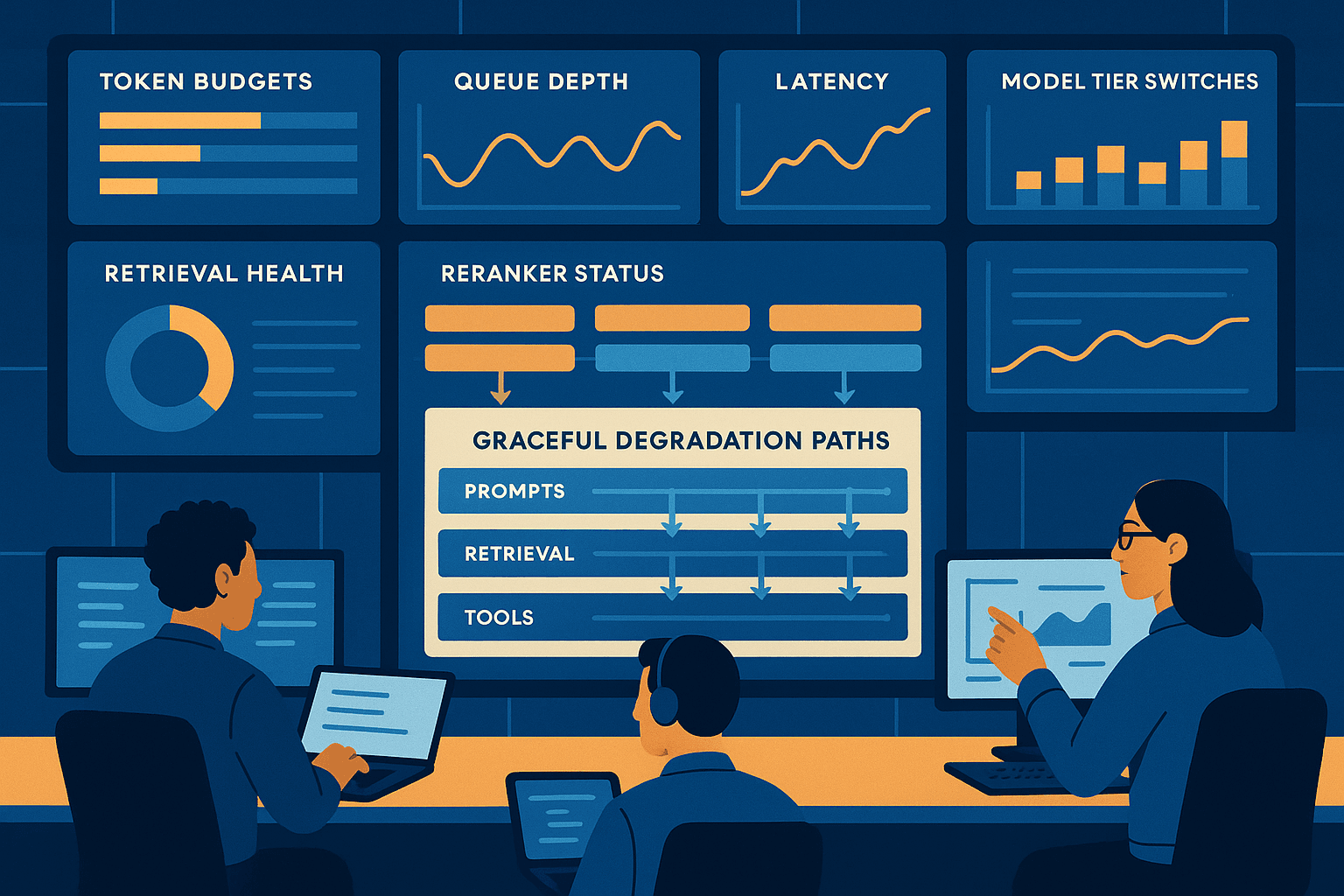
The first time many teams discover they need load shedding is not when GPU utilization hits 95%. It is when the system is still technically up, requests are still flowing, and every dashboard says “degraded but available” while users start receiving worse answers, slower answers, or no answers at all in patterns that are hard to explain. One tenant gets a thoughtful response in six seconds. Another gets a vague answer in thirty. A third receives an apology because retrieval timed out, even though the vector store is healthy and the real problem is that the reranker queue is backed up behind a surge of long-context requests. Meanwhile, your agent workflow is still trying to execute all eight planned tool steps because nothing in the architecture tells it when to stop spending tokens and dependency calls on work that no longer has a chance of completing within the user’s latency budget.
This is the uncomfortable operational truth of production GenAI: overload rarely looks like a clean outage. It looks like a gradual collapse in quality under pressure from three interacting constraints:
- token pressure: prompt growth, context windows, output lengths, and retries consuming more model throughput than expected
- queue pressure: concurrency limits, long-tail latency, and admission decisions turning moderate spikes into cascading backlog
- dependency pressure: retrieval, reranking, policy checks, tools, and downstream APIs slowing enough that the LLM path becomes the wrong place to discover failure
Traditional load shedding patterns still matter, but GenAI adds a new failure mode: the system can continue producing plausible output while silently dropping the very steps that made the output trustworthy. If your overload controls are naive, you preserve “availability” by discarding retrieval, skipping grounding, bypassing checks, or forcing weaker model configurations in ways that users cannot see and operators struggle to quantify.
The right goal is not simply to keep the endpoint up. The goal is to preserve the highest-quality safe answer possible within current capacity, while making explicit, reversible tradeoffs about what work is essential and what work can be dropped.
That requires more than rate limiting. It requires a degradation architecture.
The production scenario that forces the issue
Consider a common enterprise assistant stack:
- API gateway accepts chat and search-assist requests.
- A policy layer classifies the request, checks tenant entitlements, and determines whether retrieval or tools are allowed.
- A retriever hits a vector store and lexical index.
- A reranker scores the top 50–100 candidates.
- A context builder assembles the prompt, often with citations and instructions.
- The answering model generates a response.
- Optional agent/tool steps fetch live data or execute actions.
- Post-processing applies moderation, formatting, and logging.
Under normal conditions, this architecture works well. Under a launch event or weekday traffic spike, several things happen at once:
- query mix changes: users submit longer, more ambiguous prompts that require retrieval and longer completions
- hot documents cause cache misses in reranking and citation assembly
- one downstream dependency, like a CRM API or web search provider, adds 800 ms to every tool call
- model provider throughput tightens, increasing queue time and reducing effective tokens/sec
- retries amplify load because every timeout creates more work than the original request
The naive instinct is to “optimize latency” by shaving milliseconds from individual components. That helps at the margins, but it misses the real problem: not all work contributes equally to answer quality, and not all requests deserve the same resources under stress.
A production system needs to answer four questions in real time:
- Should we admit this request at all?
- If admitted, what is the minimum quality-preserving execution plan?
- Which optional work should be dropped first as pressure rises?
- When does degraded behavior stop being an emergency tactic and start becoming an accidental steady state?
If you cannot answer those questions explicitly, your overload response is whatever times out first.
Pattern identification: GenAI overload is budget mismatch, not just high traffic
The most useful mental model is that every request consumes multiple budgets simultaneously:
- model budget: prompt tokens, completion tokens, reasoning effort, and model-specific throughput
- latency budget: user-visible SLA or SLO targets
- dependency budget: number and latency of retrievals, reranks, tool calls, and policy checks
- risk budget: how much quality degradation is acceptable before the answer becomes misleading or unsafe
- fairness budget: how much one tenant, workflow, or request class is allowed to consume during contention
Load shedding is the control system that keeps requests within those budgets when the environment becomes hostile.
This matters because in GenAI, the expensive path is often front-loaded into optional enrichment steps. A request might technically be answerable without reranking, document expansion, or a second tool call. But removing those steps changes the quality distribution, not just the mean latency. The naive “make it cheaper” move may preserve p50 latency while destroying p95 factuality.
A better pattern is to predefine degradation ladders: ordered ways to remove cost while maintaining the highest probability of a useful, safe answer.
Those ladders should exist at multiple layers:
- prompt construction
- retrieval depth and context assembly
- reranking sophistication
- model tier selection
- agent step count and tool usage
- synchronous versus asynchronous execution
- output verbosity and formatting
The key is that these ladders are not ad hoc. They are designed, evaluated, and observable.
Why the naive approach fails
1. Flat rate limiting treats all requests as equal
A single global QPS cap is simple, but it ignores request cost. In GenAI, one “request” may be a 200-token answer with no retrieval, while another is a multi-step agent trace with 20k prompt tokens and four tools. If you meter both identically, heavy requests can crowd out lightweight ones and make user experience less fair.
You need cost-aware admission, not just count-aware admission.
2. First-failure-wins degradation drops the wrong work
Many systems degrade according to whichever dependency fails first. If reranking times out, they continue with unre-ranked retrieval. If retrieval is slow, they answer from the model without grounding. If tool execution is delayed, they still wait because the agent planner already committed to the step.
This produces inconsistent behavior and hidden quality cliffs. The user sees an answer, but the answer may no longer satisfy the product’s reliability assumptions.
3. Retry storms amplify overload
A 5% timeout rate can become a major traffic multiplier if clients, orchestrators, and tools all retry independently. In GenAI, retries are especially dangerous because each retry re-incurs prompt assembly, retrieval, and token generation costs.
Without coordinated retry budgets and idempotency, your mitigation path becomes your outage source.
4. Teams optimize component latency instead of end-to-end quality
It is easy to say “drop the reranker because it adds 150 ms.” Harder is measuring whether that increases wrong-answer rate by 8 points for ambiguous enterprise queries. GenAI load shedding decisions should be made against task-level evals, not isolated infrastructure metrics.
5. Safety is often implemented as optional post-processing
Some teams accidentally make safety or policy checks just another dependency that can be skipped under pressure. That is a serious design error. Overload control should drop nonessential work first, not the controls that prevent harmful or disallowed behavior.
Safety-critical checks need their own reserved budget and fail-closed policies for the relevant classes of requests.
6. Degradation silently becomes the architecture
This one is common. During a launch, a team disables reranking, reduces retrieval depth, downgrades the model, and forces async for long tasks. Traffic stabilizes. A week later, no one has turned the features back on because the system “seems fine.” Three months later, you have a permanently degraded product and no baseline for what good looked like.
Load shedding must be reversible, observable, and time-bounded.
A better approach: design explicit degradation ladders
A production-worthy strategy starts by labeling each unit of work as one of the following:
- mandatory: cannot be skipped without violating policy, safety, or product contract
- quality-critical: strongly affects answer correctness or user trust
- quality-enhancing: improves precision, coverage, or polish but is not always necessary
- optional: nice to have, safe to omit under pressure
- deferrable: should move to async when synchronous budgets are exhausted
Once you have that classification, you can create a degradation ladder for each request class.
For example, for a retrieval-augmented enterprise Q&A endpoint:
Tier 0: normal mode
- full policy checks
- hybrid retrieval top 50
- rerank top 50 to top 8
- document chunk expansion and citation formatting
- premium answer model
- max completion 700 tokens
- one clarification turn if ambiguity is detected
Tier 1: mild pressure
- keep full policy checks
- reduce retrieval top 50 to top 20
- rerank top 20 to top 6
- reduce chunk expansion
- cap completion at 500 tokens
- disable optional stylistic formatting
Tier 2: moderate pressure
- keep full policy checks
- use vector-only retrieval top 12 or cached hybrid retrieval
- replace cross-encoder reranker with lightweight embedding similarity rerank or skip if confidence is high
- premium model only for high-priority tenants or high-risk query classes
- standard model for low-risk requests
- no clarification turns
- completion cap 350 tokens
Tier 3: severe pressure
- keep policy and safety checks
- use cached retrieval where available, otherwise top 8 fast retrieval
- no chunk expansion
- standard model default
- no synchronous tool calls beyond mandatory ones
- force concise answer with explicit uncertainty language when evidence is thin
- route requests likely to need heavy tools into async workflows
Tier 4: protection mode
- admit only high-priority tenants and low-cost request classes synchronously
- async-only for long-form analysis and agentic tasks
- no optional tools, no expensive reranking
- strict token caps
- reject or defer low-priority work with clear user messaging
This is not glamorous architecture, but it is what keeps quality legible under stress.
The architecture: admission control plus execution shaping
Most teams think about load shedding at the edge, but in GenAI you need it at two layers:
- admission control: decide whether a request enters the system now, later, or not at all
- execution shaping: decide how much work an admitted request is allowed to do
A simple reference architecture looks like this:
1. Request classification
At ingress, compute a fast request profile:
- tenant or user priority
- endpoint type: chat, search assist, agent action, summarization, batch analysis
- predicted cost class from prompt length, expected output length, and likely retrieval/tool needs
- risk class: safety-sensitive, regulated, action-taking, customer-visible external communication, internal read-only, etc.
- latency class: interactive, near-real-time, background
The profile should be cheap to compute. Do not invoke an LLM for this step unless you already have a tiny highly reliable classifier and the latency is acceptable. Most production systems can derive enough from endpoint metadata, prompt length, route configuration, and a few lightweight heuristics or compact models.
2. Capacity state estimator
Continuously estimate current pressure using metrics that actually predict collapse:
- queue depth by model tier
- wait time to first token
- effective tokens/sec by model/provider
- prompt token and completion token burn rates
- retrieval latency and error rate
- reranker backlog
- tool/API timeout rates
- percentage of requests hitting fallback tiers
- retry volume and duplicate work rate
You can collapse these into a small set of pressure states such as Normal, Elevated, High, Severe, but keep raw metrics visible for debugging.
3. Admission policy engine
The policy engine combines request profile and capacity state to decide:
- admit sync
- admit with degraded execution plan
- enqueue async
- reject with retry-after or quota message
This decision should be deterministic and explainable. An example policy:
- regulated/action-taking requests require reserved headroom and may preempt lower-priority traffic
- premium tenant interactive Q&A admitted through Tier 2 degradation before async deferral
- free-tier long-context summarization goes async in High pressure and rejects in Severe pressure
- exploratory agent workflows above a token estimate threshold are blocked from sync execution once queue wait exceeds N seconds
4. Execution planner with budgets
Once admitted, every request gets explicit budgets:
- max prompt tokens
- max completion tokens
- max retrieval fanout n- max rerank candidates
- max tool steps
- max wall-clock latency
- sync/async mode
The planner allocates these budgets to workflow steps. Critically, it should be able to terminate optional work when upstream delays consume too much of the wall-clock budget. This avoids the common anti-pattern where retrieval took too long but the LLM still attempts the full answering path as if nothing happened.
5. Budget-aware orchestrator
Your orchestration layer needs cancellation and deadline propagation. If the request has 3.5 seconds left, downstream calls need to know that. If the reranker missed its budget, the context builder should not wait indefinitely. If the planner says “no second tool step,” the agent loop must stop.
This sounds obvious, but many LLM stacks are built from components that do not share budgets cleanly. Fix that early.
Preserving quality while dropping work
The art of load shedding is choosing what to drop first.
A good principle is: drop work whose marginal value is low and whose failure mode is transparent. Keep work whose marginal value is high or whose absence creates invisible trust failures.
Good early candidates to drop
- decorative or verbose output formatting
- nonessential chain-of-thought-like internal scaffolding, if you still use hidden reasoning templates that increase tokens
- retrieval fanout beyond the point of diminishing returns
- expensive reranking on high-confidence easy queries
- second-pass polishing or rewrite models
- optional tool enrichment such as fetching “nice to know” metadata
- long answer lengths when a concise answer satisfies the use case
Work to preserve as long as possible
- safety and policy enforcement
- grounding for queries where correctness depends on external/private knowledge
- critical disambiguation in high-risk workflows
- action validation before write operations
- tenant isolation checks and authz
- provenance/citation where your product contract relies on it
The subtle cases
Reranking is a good example. On some corpora, dropping the cross-encoder reranker barely changes answer quality for easy navigational queries. On others, it sharply increases hallucinations because low-quality chunks slip into context. You cannot decide this in the abstract. You need evals segmented by query type.
Similarly, downgrading from a premium model to a faster cheaper model might be harmless for extraction or short summarization, but damaging for multi-document synthesis or policy-heavy tasks. Again: class-specific degradation, not blanket fallback.
Synchronous versus asynchronous execution is a core load-shedding lever
One of the biggest mistakes teams make is treating sync versus async as a product decision rather than an overload control.
Interactive users care about responsiveness, but they do not always need the complete heavy workflow before they can move on. Many expensive GenAI tasks should be designed to degrade into async mode gracefully.
Examples:
- “Draft a detailed analysis” can return a short immediate answer plus an async job for the full report.
- “Investigate these 20 accounts and summarize anomalies” should never compete equally with a short Q&A request in the same synchronous pool.
- agentic research workflows can return “I’ve started this task and will notify you” once queue or dependency budgets are exceeded.
This requires product support, not just infrastructure. The UI and API contract need to make async feel first-class. If the product only supports sync responses, your overload options are much narrower.
Model tiering and tool choices under pressure
Production GenAI systems usually have more levers than teams admit:
- premium frontier model
- mid-tier fast model
- compact model for classification, routing, compression, and low-risk generation
- cached responses or semantic cache for repetitive prompts
- CPU-friendly lexical retrieval path when vector systems are stressed
- lightweight rerankers versus cross-encoder rerankers
The right tiering strategy is workload-specific, but some common patterns hold:
Use small models for control-plane tasks
Classification, routing, query rewriting, and context compression often do not need your best model. Offloading these tasks reduces pressure on premium generation capacity. But measure drift: an inaccurate query rewrite model can increase retrieval miss rate and make the overall system worse.
Keep a “safe cheap path”
You want at least one execution mode that is materially cheaper but still trustworthy for a meaningful slice of requests. That might mean:
- small or mid model
- fast retrieval top 8
- no expensive reranker
- concise grounded answer
If your only fallback is “same architecture, just slower and worse,” you do not have a real shedding strategy.
Compare cost in end-to-end terms
A more expensive model with stronger grounding use may reduce retries, tool calls, and user follow-ups enough to be cheaper at the system level. Conversely, a cheaper model that requires more retrieval expansion and more second-turn corrections can raise total cost under load.
Always compare:
- cost per successful task
- p95 latency per successful task
- wrong-answer rate under degraded modes
- operator overhead from incidents and overrides
Evaluation strategy: if you cannot measure degraded quality, you are flying blind
Load shedding cannot be validated with infrastructure tests alone. You need a dedicated overload eval suite.
At minimum, build an evaluation matrix across:
- request classes: factual Q&A, summarization, agentic lookup, action-taking, support responses, analytics
- pressure tiers: normal, elevated, high, severe
- degradation modes: reduced retrieval, no rerank, smaller model, async shift, lower token caps, fewer tool steps
- quality metrics: task success, factuality, citation correctness, policy compliance, refusal correctness, user-rated helpfulness
- system metrics: latency, queue time, token cost, dependency calls, timeout rate
Offline evals
Construct a representative dataset and replay each request class through every degradation tier. Score:
- answer correctness versus gold labels or adjudication
- grounding quality and citation support
- safety/policy adherence
- length and completeness relative to task expectations
- sensitivity to missing retrieval or shorter context
Do not only compute aggregate scores. Slice by query difficulty, ambiguity, and dependency reliance.
Online shadow and canary tests
When introducing or changing load shedding, shadow traffic can show whether a proposed Tier 2 plan materially harms quality before users see it. Canary by tenant or endpoint. Do not roll out fallback policies platform-wide without evidence.
Chaos-style dependency drills
Simulate realistic failure modes:
- vector store latency doubles
- reranker throughput halves
- one model provider imposes a tighter rate limit
- tool API returns intermittent 429s
- completion tokens/sec drops by 40%
Then verify:
- pressure state changes quickly enough
- admission policies activate predictably
- optional work is dropped in correct order
- safety stays intact
- the system recovers cleanly when pressure subsides
Human review on quality cliffs
Some degraded outputs remain superficially acceptable while becoming strategically bad: vaguer, less cited, or more likely to overstate confidence. Sample and review them. Human spot checks are still necessary.
Observability: make degraded behavior impossible to ignore
You need more than latency dashboards. Specifically, you need to know not only that the system is degrading, but how often each degradation path is being used and whether it is becoming normal.
Track at least the following:
Pressure and capacity
- queue depth and queue age by model tier
- wait-to-first-token and total generation latency
- tokens/sec realized versus expected
- admission decisions by class
- async deferrals and rejections
Degradation usage
- percentage of requests by degradation tier
- retrieval fanout distribution over time
- reranker enabled/disabled rate
- model tier fallback rate
- average tool steps executed versus planned
- token cap truncation rate
- percentage of grounded answers with fewer than expected citations
Quality and safety under degradation
- task success proxies by tier
- factuality or citation-support audits
- refusal correctness and policy violations
- user dissatisfaction signals: retries, rephrases, thumbs-down, abandonment
Recovery and rollback signals
- time spent in each pressure state
- time to restore normal mode after pressure clears
- manual overrides still active after incident end
- degradation paths active beyond approved window
One practical pattern is to attach a machine-readable “execution profile” to every request. Log fields such as:
- request_class
- pressure_state
- admitted_mode
- degradation_tier
- model_used
- retrieval_count
- reranker_mode
- tool_steps_executed
- sync_or_async
- token_budget_used_pct
- fallback_reason
This becomes invaluable for incident analysis and quality trending.
Admission and backpressure policies tied to user and tenant priority
In multi-tenant systems, fairness matters as much as raw uptime. Without explicit policy, your heaviest or noisiest tenants consume disproportionate capacity during contention.
A practical approach is to combine three controls:
1. Reserved capacity pools
Reserve portions of capacity for:
- premium or contractual tenants
- high-risk workflows requiring stronger guarantees
- internal operator/admin paths needed to manage incidents
Be careful not to over-reserve or you will strand capacity. But some reservation is usually necessary.
2. Weighted fair queuing or token-based fairness
Queueing by request count is insufficient. Use a cost estimate, such as predicted prompt+completion tokens plus dependency cost, and allocate service proportionally. This reduces the chance that one agent-heavy tenant starves everyone else.
3. Backpressure at the client boundary
Return clear signals:
- Retry-After with jitter guidance
- explicit async job creation
- quota or concurrency exceeded errors
- user-visible messaging that a concise answer is provided now and a full report will follow
The user experience of backpressure matters. A clean defer is often better than a slow low-quality synchronous answer.
Implementation details that matter in practice
Deadline propagation
Every downstream call should know the remaining deadline, not just a generic timeout. If the request has 900 ms left, the retrieval service should not use its normal 2-second timeout.
Cancellation support
When a request is rejected, deferred, or superseded, in-flight retrieval and tool work must be canceled. Otherwise your load shedding reduces front-end pain while back-end systems continue drowning in useless work.
Coordinated retry budgets
Set retry budgets per request and per dependency. If a dependency is failing due to overload, retries should rapidly collapse, not compound.
Token budgeting before generation
Estimate token usage before dispatching to the model. Reject or reshape pathological prompts early. Common controls include:
- prompt compression
- dropping low-value context
- hard max output tokens by route
- converting “analyze everything” requests into async jobs
Prompt templates for degraded modes
Do not use the exact same prompt across all pressure states. Create degraded-mode prompts explicitly:
- instruct concision
- ask the model to state uncertainty when evidence is sparse
- require grounding only on provided sources
- avoid open-ended exploration when tool steps are capped
Prompt design is part of load shedding.
Caching
Semantic and retrieval-result caching can buy you meaningful headroom, especially for repeated enterprise queries. But cache policy must include freshness and authz constraints. Under pressure, cache hits can keep quality high while reducing dependency load.
Circuit breakers for flaky dependencies
If a tool or provider is degraded, trip a circuit breaker and route requests to plans that do not depend on it, rather than letting each request rediscover the failure. This is standard distributed systems practice and absolutely applies here.
Guardrails on agent loops
Agentic systems are particularly dangerous under overload because they turn uncertainty into more steps. Put hard limits on:
- total tool calls
- repeated tool calls of the same type
- recursive planning depth
- cumulative tokens spent in planning versus answering
When in doubt, fail into a constrained answer or async escalation.
Cost and latency tradeoffs: what to expect
There is no universal degradation ladder, but some broad tradeoffs are common.
Reducing retrieval depth
- latency benefit: moderate to high
- cost benefit: moderate
- quality risk: low for easy queries, high for broad or ambiguous queries
Dropping expensive reranking
- latency benefit: moderate
- cost benefit: moderate
- quality risk: highly corpus-dependent; can be severe for noisy retrieval sets
Shorter outputs
- latency benefit: moderate
- cost benefit: high when completions are long
- quality risk: often low if the product supports concise answers; can be high for explanation-heavy tasks
Model downgrade
- latency benefit: high
- cost benefit: high
- quality risk: task-dependent; often acceptable for extraction/classification, risky for synthesis/judgment
Fewer tool steps
- latency benefit: high
- cost benefit: high
- quality risk: acceptable if later steps are enrichment; risky if they validate critical facts or actions
Async deferral
- latency benefit: maximal for synchronous path
- cost benefit: indirect but strong because it protects the interactive pool
- quality risk: low if UX supports it; high if users actually need immediate completion
The operational lesson is simple: preserve the things that make answers trustworthy, and cut the things that make them luxurious.
Rollback criteria: prevent emergency controls from becoming default architecture
Every load-shedding control should have explicit rollback rules. Examples:
- if queue wait falls below threshold for 15 minutes, restore reranking for affected classes
- if model throughput normalizes, revert premium tenants from Tier 2 to Tier 0
- if dependency health recovers, reopen tool paths gradually via canary
- if a manual override remains active beyond one incident window, page the owning team for review
Also maintain a “degradation debt” dashboard:
- controls currently active
- who activated them
- why
- expected expiry time
- measured quality impact
This sounds bureaucratic until you discover half your product has been running in incident mode for a quarter.
A concrete rollout plan
If your system has little explicit overload handling today, do not try to build the perfect policy engine in one shot. Roll it out in stages.
Phase 1: visibility
- instrument request classes, token usage, queue time, retrieval/tool dependency latency
- log execution profiles and fallback paths
- define quality baselines for major workloads
Phase 2: simple budget controls
- per-route token caps
- max tool-step limits
- sync/async split for obviously long-running workflows
- coordinated retry budgets
Phase 3: degradation ladders
- define Tier 0–Tier 3 plans for top request classes
- evaluate offline against quality datasets
- ship behind feature flags
Phase 4: admission policy
- add tenant priority and predicted cost classes
- implement weighted fairness and reserved capacity
- canary pressure-state automation
Phase 5: drills and automation
- run dependency-failure simulations
- verify rollback criteria
- automate restoration to normal mode
This staged approach is usually more successful than trying to leap directly into a fully dynamic controller.
The real takeaway
Load shedding in production GenAI is not about keeping the API green at all costs. It is about deciding, ahead of time and with evidence, what work is essential to preserve trust and what work can be sacrificed when tokens, queues, or dependencies become constrained.
The teams that handle overload well do a few things consistently:
- they classify requests by cost, risk, and user importance
- they treat admission and execution shaping as separate controls
- they design explicit degradation ladders instead of relying on accidental timeouts
- they preserve safety, grounding, and validation longer than polish and enrichment
- they evaluate degraded modes against task quality, not just component latency
- they make fallback usage visible and reversible
If you do this well, overload becomes a controlled reduction in luxury rather than a chaotic loss of trust. Users may get shorter answers, delayed heavy workflows, or fewer enrichments during spikes. What they should not get is a system that looks available while silently abandoning the steps that made it reliable.
That is the standard worth engineering for in GenAI: graceful degradation that protects correctness, safety, and fairness before it protects appearance.